Quick answer: A frame stage inspection happens after the timber wall and roof framing is up and the bracing is on, but before plasterboard goes on. It’s your last chance to catch structural defects before they’re hidden inside walls. An independent VBA-registered inspector checks tie-downs, brackets, lintels, bracing, and conformance with engineering plans — typically 1.5–2 hours on site.
Why frame stage matters most
If your inspection picks up a defect during the frame stage, fixing it costs the builder a few hours. If the same defect is found at handover, fixing it means tearing out plaster, paint, cabinetry, sometimes the kitchen. Frame stage is the cheapest possible repair window — for the builder, that means the easiest concession.
Once plaster is on, you can no longer see what’s holding the roof up.
What we check at frame stage
A proper frame stage inspection by a VBA-registered builder covers:
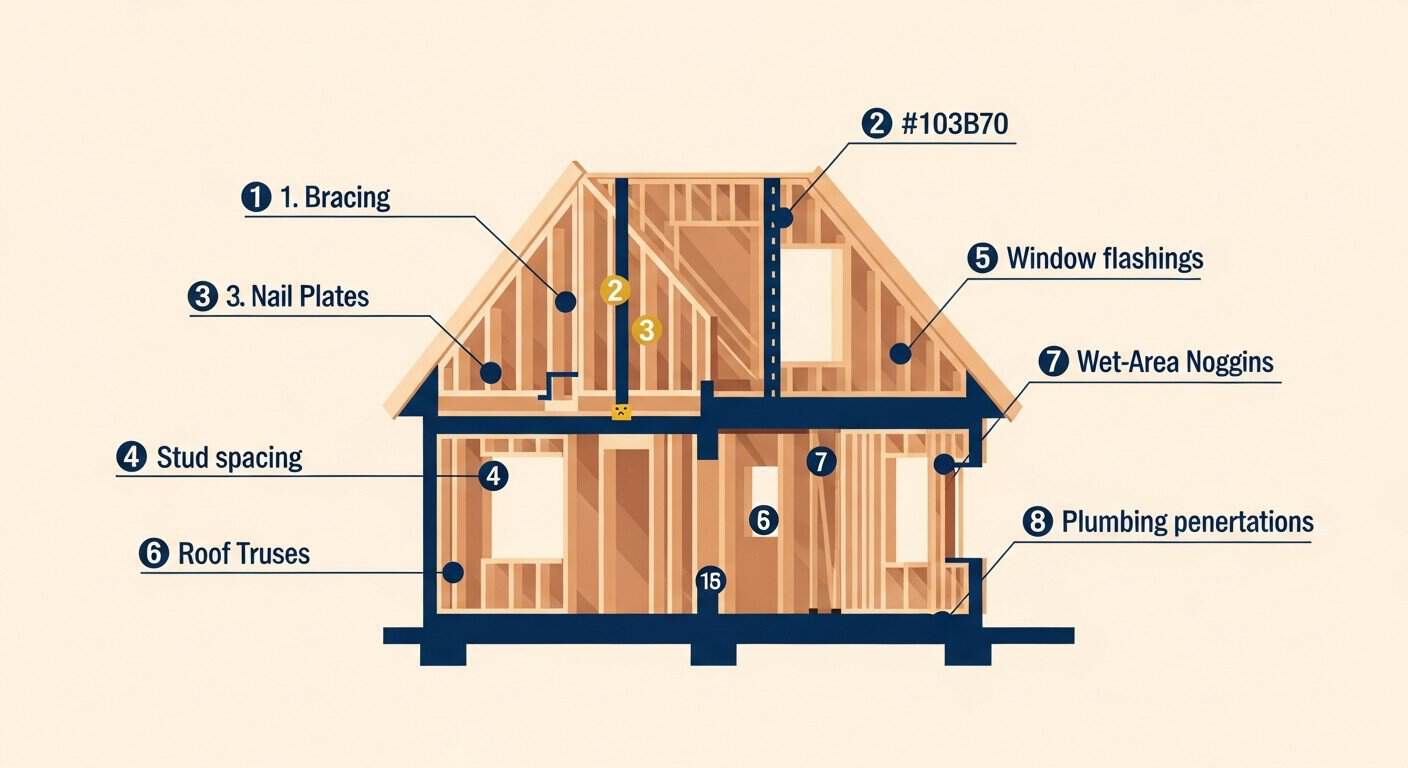
- Tie-downs — every truss, every wall plate, hold-down brackets per the structural engineer’s plans. Cyclonic-rated bracing in exposed western-suburbs sites.
- Wall brackets and tek-screws — pattern, count, and gauge match plan. Triple-grip brackets on long-span trusses, not just nail plates.
- Lintels — sized correctly for the span and load. Steel lintels above 2.4m openings; correct timber grade and dimensions for shorter spans.
- Bracing — temporary and permanent diagonal bracing, racking strips, structural sheet bracing as specified.
- Stud pattern and spacings — 450mm or 600mm centres per plan, no missing studs around plumbing penetrations.
- Truss installation — correct truss type at each location (girder vs standard), bird’s-mouth cuts at correct angle, no field-cut modifications.
- Wet-area framing — extra studs and noggins for tile substrate; tanking-ready stud spacing.
- Window and door openings — square and plumb; lintels, jamb studs, sill trimmers.
We compare every framing element to the structural engineering drawings and the National Construction Code (NCC) Volume 2.
Common defects we find at frame stage
Across hundreds of frame inspections in Melbourne’s western suburbs (Hoppers Crossing, Tarneit, Truganina, Wyndham Vale), the recurring issues:
- Missing or wrong tie-downs — the most common defect. Trusses sitting on top plates with no bracket, or wrong bracket type substituted on site.
- Triple-grip brackets installed upside down — they only work in tension when oriented correctly.
- Field-cut trusses — apprentices trimming a truss to fit a service penetration. Engineering void.
- Out-of-plumb walls — beyond AS 1684 tolerance; corrects easily before plaster, hides forever after.
- Missing noggins in wet areas — no substrate for tile backing.
- Wrong lintel size — undersized for the span; visible deflection over time.
Your builder’s frame inspection vs an independent one
Building right now?
Star catches stage defects while your builder still has to fix them. Slab, frame, lock-up, fixing, PCI.
Your builder’s frame inspector works for the builder. Independent inspectors work for you. They’re not paid by the volume of homes inspected; they’re paid for the defects they document. An independent VBA-registered builder reading the engineering plans against the framing as built will routinely flag 5–15 defects on a typical new-home frame.
Frequently asked questions
When do I book a frame inspection?
Book as soon as bracing is up and the building is “weatherproofed” enough to inspect — but before plasterboard arrives. Your builder will notify you when frame stage is reached. Book the inspection within a few days of that notification.
How long does a frame inspection take?
1.5–2 hours on site for a standard 4-bedroom home. Photo-rich written report delivered the same day, by 6pm.
Will my builder fix frame defects?
Yes — they’re contractually required to. The frame must conform to the engineering plans, NCC, and AS 1684. A defect documented in writing pre-plaster is not a negotiation; it’s a punch-list item the builder must rectify.
What if my builder pushes back on the inspector’s findings?
Most reputable builders welcome independent inspections. Builders who push back are usually the ones whose framing needs the most scrutiny. The VBA Practice Standard requires builders to remedy non-conforming work — your inspection report is the documented basis for that.
Book a frame stage inspection
New Home Stage Inspections — Melbourne West — VBA-registered builder, four-stage inspections, same-day reports.
Related guides:
– The 5 Stages of a New Home Build (and What to Inspect at Each)
– Why Your Builder’s Inspection Is Not Enough
– PCI Checklist — What to Inspect Before Signing Handover
Call Michael direct on 0412 014 216 to book your frame stage inspection — same-day photo-rich reports.
Frame stage inspection — 6 critical checks
What customers say about Star
When you book Star
Your builder's "inspector" is paid by the builder. Their job is to sign off, not to find defects. By the time you spot the issue at handover, contracts are signed and the build company has moved on.
Star is an independent VBA-registered builder hired by you, not by the builder. We attend at slab, frame, lock-up, fixing and PCI stages — finding defects while the builder still has to fix them under contract.
How we grade defects
Across Melbourne's west
Why customers choose Star
Why book Star Building Inspections?
Star Building Inspections is owned and operated by Michael Tuder — a VBA-registered builder with 20+ years inspecting homes across Melbourne's western corridor. Michael personally attends every inspection, writes every report, and calls every customer to walk them through the findings line by line. No contractors. No rotating staff. No outsourced sign-offs.
Book your stage inspection
Slab, frame, lock-up, fixing or PCI — independent oversight catches defects while your builder still has to fix them under contract.