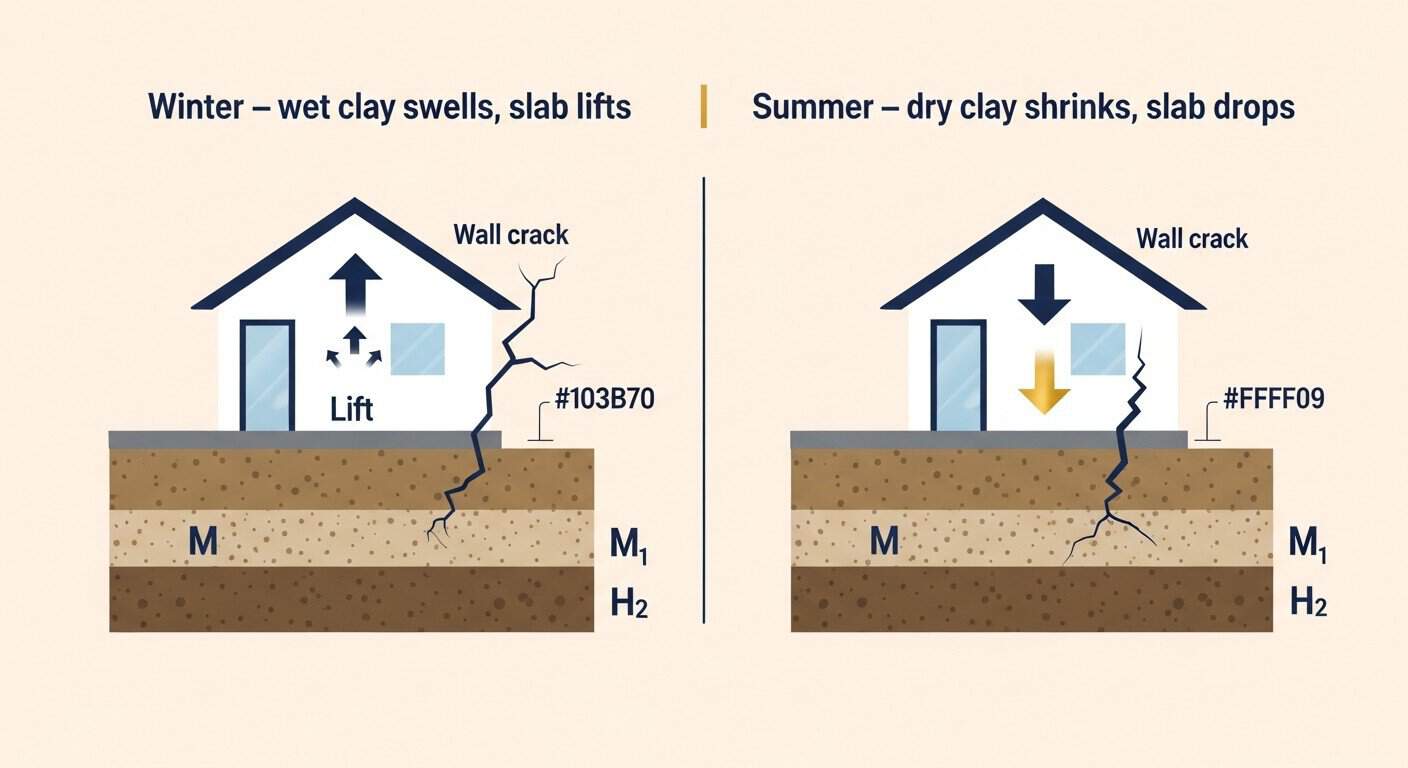
Quick answer: Most of Melbourne’s western suburbs sit on highly reactive clay soils that swell when wet and shrink when dry. This movement causes wall cracks, sloping floors, sticking doors, and slab heave — common defects flagged in pre-purchase building inspections across Hoppers Crossing, Werribee, Point Cook, Tarneit and Wyndham Vale.
What “reactive clay” actually means
Reactive clay is a soil classification under AS 2870 — the Australian Standard for residential slabs and footings. The classes range from A (stable, sand or rock) through H1 / H2 (highly reactive) and E (extremely reactive).
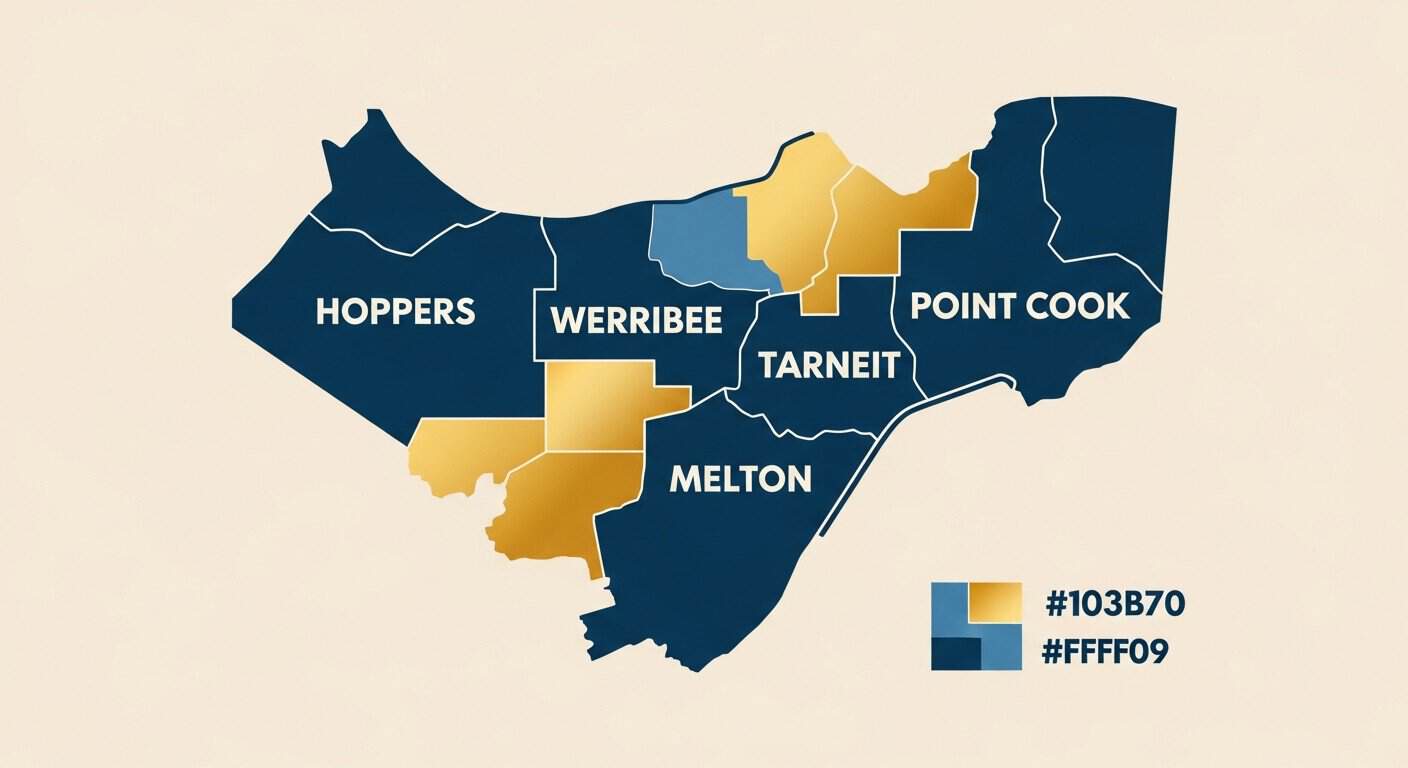
Melbourne’s western corridor — Hoppers Crossing, Werribee, Point Cook, Tarneit, Truganina, Williams Landing, Plumpton, Melton — is dominated by Class M and H1 sites, with pockets of H2 in the older Werribee/Wyndham Vale flats. This means the ground genuinely moves with the seasons: it expands when saturated in winter, contracts in summer drought.
A house built without footings designed for this movement will move with it. And visibly, year after year.
Common defects we flag in western Melbourne homes
Across hundreds of pre-purchase inspections in the western suburbs, the same patterns turn up:
- Stair-step cracks in brickwork — diagonal cracks following the mortar joints, usually at corners, lintels, and around windows. Anything wider than 5mm warrants further investigation.
- Vertical cracks in cornices and ceiling/wall junctions — often the first internal sign of slab movement.
- Sloping floors — drop a marble, see if it rolls. We measure with a digital level — anything beyond 1:200 fall is a red flag in a home under 30 years old.
- Doors and windows binding — frames out of square as the slab moves. Common in the rear bedrooms of homes facing south.
- Render cracking and detachment — particularly on rendered brick veneer homes built 2005-2015.
- Slab heave in wet areas — bathrooms and laundries that develop a “high spot” in the centre of the floor over time.
Why western Melbourne is different from inner east
Inner-east Melbourne (Camberwell, Hawthorn, Box Hill) sits largely on Class A or S soils — far more stable. Houses built on those soils tolerate construction shortcuts that western-suburbs homes cannot. A 1970s brick veneer that’s standing dead-flat in Box Hill might be visibly twisted on the same footing design in Werribee.
This is why a “generic” national-chain inspector who doesn’t know western Melbourne soils will miss things. They’ll note “minor cracking, monitor” — the cracks they shrug off in Box Hill are the cracks that define the sale price in Hoppers Crossing.
What we do differently
Need this inspection booked?
Star books inside the cooling-off window. 48-hour turnaround, same-day report, phone walkthrough.
Star Building Inspections is run by Michael Tuder, a VBA-registered builder based in Hoppers Crossing. Every inspection we do across the western corridor accounts for soil reactivity: we read the cracks, the slab levels, the door clearances, and the subfloor moisture in the context of this is reactive clay country.
Our reports cite the AS 2870 site classification when relevant, note whether the home’s footing matches the soil class, and flag movement that’s normal seasonal cycling vs. progressive structural failure.
What to do if a property shows movement
A pre-purchase inspection that flags reactive-clay movement is a starting point, not a deal-breaker. Options:
- Negotiate — bring the inspection report to the table; reduce the offer by an amount that covers remediation (typically $5K–$50K for crack repair, articulation, or partial underpinning).
- Engineer’s review — for serious movement (cracks >10mm, sloping >1:100, slab heave), a structural engineer can quantify the cost.
- Walk away — if the movement is progressive and the soil class is H2/E with shallow footings, this house will continue to move regardless of cosmetic repair.
A good inspection report tells you which option this house calls for. That’s the value.
Frequently asked questions
Are all western suburbs Class M or worse?
Mostly yes. The western volcanic plains (Werribee, Hoppers Crossing, Wyndham Vale, Point Cook, Tarneit) are dominated by reactive clay. Some pockets of better soil exist near old creek lines and elevated ridges. Your geotechnical report (if available) is the source of truth.
Can a builder fix reactive clay movement?
Underpinning, articulation joints, and slab stiffening can stabilise an existing home — but it’s expensive ($30K–$80K typical). The fix is to start with footings designed for the soil. New estates 2010+ generally do this; older estates often don’t.
Should I avoid buying in the western suburbs?
No. The vast majority of homes are perfectly serviceable for decades. The point of inspection is to know which homes have movement that’s stable vs. progressive — and to negotiate accordingly.
Do new homes in Tarneit / Truganina have this issue?
Less so, because the footing standard improved post-AS 2870 (2011). New homes on H1 sites should be on stiffened raft slabs designed for the movement. We still inspect these — the issue shifts from “is this slab adequate” to “was it built to plan.”
Book a pre-purchase building and pest inspection
Pre-Purchase Building & Pest Inspection — Melbourne West — VBA-registered builder, same-day reports, fixed pricing.
Related guides:
– What Does a Pre-Purchase Building Inspection Actually Check?
– 5 Defects Pre-Purchase Inspections Find in Older Melbourne Homes
– How Much Does a Building and Pest Inspection Cost in Melbourne (2026)?
Call Michael direct on 0412 014 216 for a quote or to book — same-day reports, all of Melbourne’s western suburbs.
How soil class affects slab movement risk
What customers say about Star
How we grade defects
The standard buyer pre-purchase inspection often gets booked late — after the 3-day cooling-off period clock has started — and the report comes back too late, or too vague, to use as leverage.
Star books inside the cooling-off window, attends within 48 hours, and writes a report you can actually take to the agent. Photos of every defect, severity grades, and a phone walkthrough so you know what matters before you sign.
Why customers choose Star
Across Melbourne's west
Chain inspectors vs Star
| Factor | Chain inspector | Star (independent) |
|---|---|---|
| Inspector continuity | Rotating staff | Michael every time |
| VBA-registered builder | ✗ | ✓ |
| Report walkthrough | ✗ | yes — phone call |
| Same-day report | ✗ | yes (by 6pm) |
| Cost | $300-450 | $450-650 |
Why book Star Building Inspections?
Star Building Inspections is owned and operated by Michael Tuder — a VBA-registered builder with 20+ years inspecting homes across Melbourne's western corridor. Michael personally attends every inspection, writes every report, and calls every customer to walk them through the findings line by line. No contractors. No rotating staff. No outsourced sign-offs.
Book your pre-purchase inspection
Cooling-off period running? Star books within 48 hours, attends in person, and delivers your report same day.