
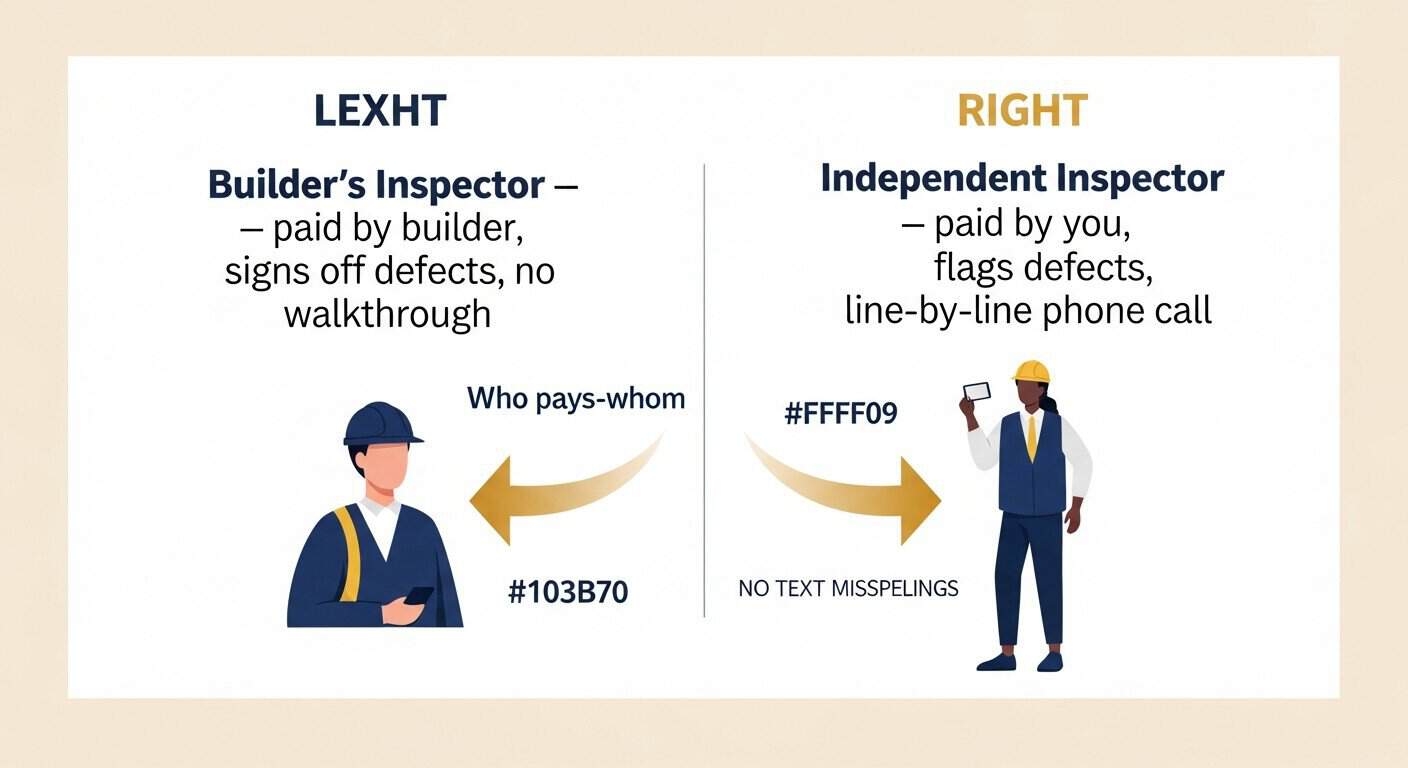
Volume builders across Melbourne’s west run their own quality assurance. Site supervisors check the work, sign off the stage, and clear the next progress payment. Buyers are told this is the inspection — and many believe it. After 30+ years on the tools and inspecting hundreds of new builds, I can tell you it is not the inspection. It is internal QA by the company you are paying. An independent inspection is something else entirely. Here is the difference, and what we find on builds that have already been “signed off.”
Quick answer: A builder’s inspection is internal quality assurance — the same company building your home decides if the work meets standard. An independent inspector works for you, has no commercial interest in approving the stage, and is bound only to the contract, the plans, and the National Construction Code. Independent inspectors routinely find 20 to 50 defects per stage that the builder’s QA missed or did not flag.
The conflict of interest
Your builder’s site supervisor has three jobs:
- Keep the build on schedule
- Keep the build on budget
- Sign off the work
The first two pull against the third every time. A site supervisor who flags every defect slows the build, delays trades, and costs the builder money. A site supervisor who waves the build through hits the schedule and protects the margin. Even with the best intentions, that is the structural pressure.
An independent inspector has none of those pressures. We are paid to find what is wrong, document it with photos, and hand you a list. The defects exist regardless — the question is whether anyone tells you about them.
What we find that the builder did not flag
Across the western suburbs — Hoppers Crossing, Tarneit, Point Cook, Truganina, Werribee — these are the issues we find regularly on builds that have already been signed off internally.
Frame stage
- Bracing under-fixed or in the wrong orientation. The engineer’s plan calls for a particular bracing arrangement; the trade installs it differently because it is faster, then nobody checks against the plan.
- Tie-down screws missed. Hold-down brackets are visible. Screws not fully driven are easy to miss unless you are looking.
- Truss bracing skipped. “The truss company will do it” — except they do not, and the framer assumed they would.
- Lintels under-sized or missing. Window heads above standard openings sometimes get a single timber where the engineer specified a multi-member lintel.
- Plumbing penetrations through structural members in non-compliant locations.
Lockup stage
- Articulation joints missing in long brick walls. Melbourne’s reactive clay soils make these mandatory. We see them missed in 80m+ continuous walls regularly.
- Weep holes blocked or wrong height. Mortar smears, blocked weeps, or weeps installed below the damp course render the brick veneer drainage useless.
- Roof flashings short. Apron flashings, valley flashings, and chimney flashings cut to fit the day’s work, not to lap correctly.
- Sarking torn or discontinuous. Rips behind cladding stay rips for the life of the building.
Fixing stage
- Wet-area waterproofing completed without an inspection point. The waterproofing membrane is signed off by the trade who applied it, then tiled over. If it fails, the entire bathroom comes back out.
- Plasterboard joins not fully set. Visible only under raked light or after the first paint coat — easy to skip.
- Doors hung with uneven gaps. Cosmetic until the home settles, then they bind.
PCI stage
- Paint finish defects under raked light — roller marks, lap lines, pinholes
- Tile lippage above tolerance
- Hairline plaster cracks at internal corners
- Sealants and silicones ragged, gappy, or incomplete
- Items still on the trades list quietly dropped from the scope
For the full PCI walk-through, see our PCI checklist.
Real defects, real cost differences
The pattern repeats. A defect caught at frame stage costs the builder one trade visit. The same defect caught at PCI costs a re-strip, refit, and redecorate. The same defect caught after handover often becomes the buyer’s problem under the warranty maze.
| Defect | Found at frame | Found at PCI | Found post-handover |
|---|---|---|---|
| Missing bracing | One trade hour | Open up cladding to fix | Often unrepairable without major work |
| Plumbing penetration wrong location | Move pipe before slab | Chase through finished floor | Cosmetic patch only |
| Wet-area waterproofing failure | Re-membrane | Strip tiles, re-membrane, re-tile | Rebuild after damage |
| Articulation joint missing | Cut joint in mortar | Saw-cut and seal | Wall cracks, retrofit fix |
| Tie-down under-fixed | Drive screws | Open up cladding | Compromised structure |
A $400 stage inspection that finds one tie-down defect at frame has paid for itself many times over.
What the builder will say
Builders often push back when an independent inspector is engaged. The lines are predictable:
- “Our QA already covers this.” It does not. It covers their commercial risk, not yours.
- “Independent inspectors are not allowed on site.” They are, with reasonable notice, under standard residential contracts. Refusing access is a flag.
- “They will just find cosmetic stuff to justify their fee.” A real independent inspection finds cosmetic and structural items, with photos and references to the plan or code. Cosmetic items get fixed. Structural items get escalated.
- “This will delay the build.” Defects fixed at the right stage do not delay the build. Defects fixed at the wrong stage absolutely do.
A confident builder welcomes an independent inspector. A defensive builder is a flag.
What independent inspectors do not do
Building right now?
Star catches stage defects while your builder still has to fix them. Slab, frame, lock-up, fixing, PCI.
To be fair to builders, independent inspectors are not a complete solution.
- We do not project-manage the build
- We do not chase trades
- We do not negotiate with the builder on your behalf
- We are not contract administrators or solicitors
- We do not certify the build for occupancy — that is the building surveyor
Our job is narrower: walk the site at each stage, document what was done and what was missed, and hand you a defect list. You then use that list as the buyer in your dealings with the builder.
How to engage an independent inspector
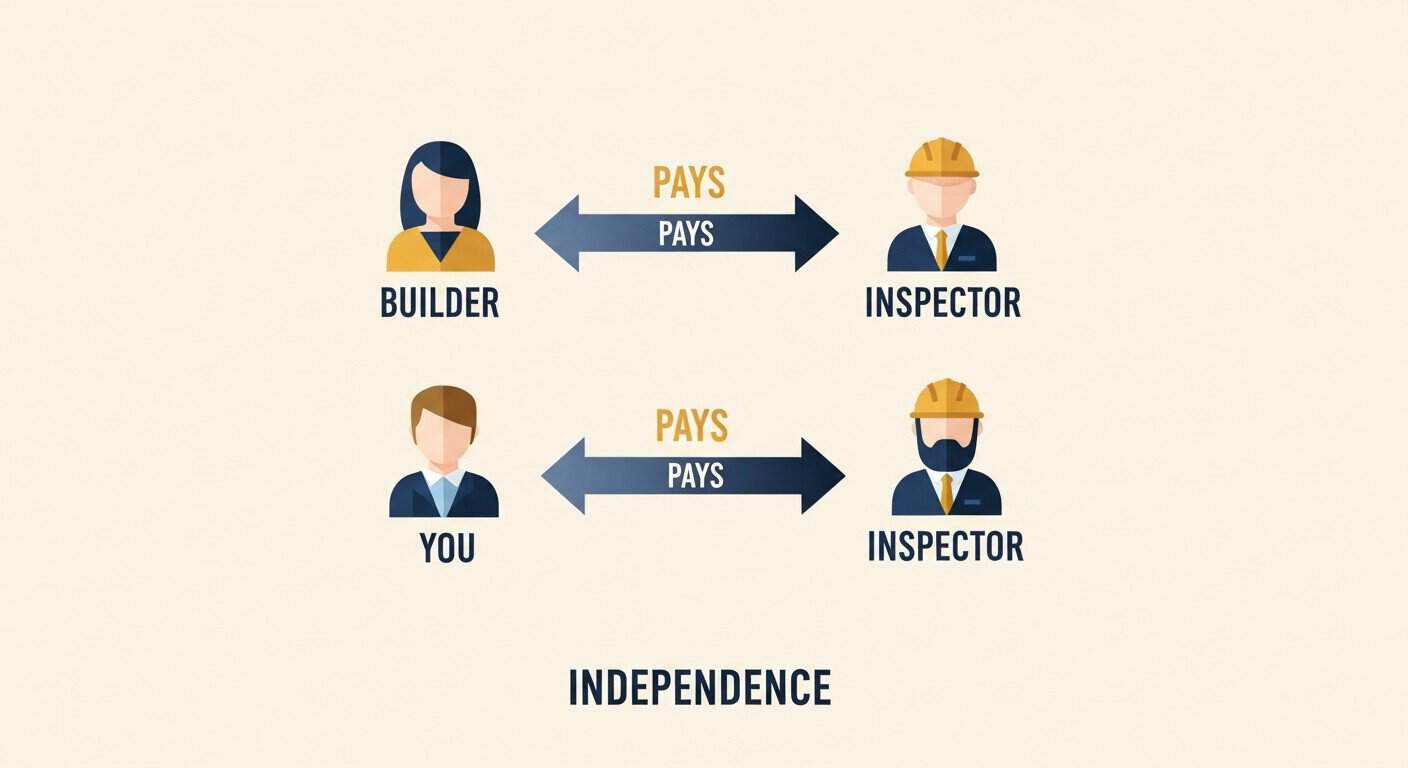
The earlier the better. By the time you are mid-build, you have already missed the cheapest stages to inspect. The right time to engage is before the slab is poured so the base inspection is the first stage covered. Five-stage inspection packages typically run $1,500 to $2,500 across the build — see our post on the five stages of a new home build for the full breakdown.
Most independent inspectors (Star Building Inspections included) deliver photo-rich same-day reports. You forward the report to your builder, the builder rectifies before the next stage starts, and your build moves forward with documented quality.
Frequently asked questions
Will engaging an independent inspector damage my relationship with the builder?
A reasonable builder treats independent inspections as normal. Many of the better volume builders in Melbourne now expect them. If your builder reacts badly to the idea, that tells you something useful.
Can the builder refuse to fix the defects we find?
The builder must build to the contract, the plans, and the code. If our defect list points to a non-conformance, the builder is obliged to rectify under the contract. Disputes go through the standard resolution mechanisms — talk to your conveyancer or solicitor.
Are independent inspectors qualified to find structural defects?
Look for a registered builder (VBA registered in Victoria) with stage inspection experience. We work to the National Construction Code and the engineer’s plans for the specific build. We are not structural engineers — for serious structural concerns we recommend an engineer’s report.
What happens if the inspector misses a defect?
Reputable inspectors carry professional indemnity insurance. The report covers what was reasonably accessible and visible at the time. Hidden defects (concealed framing after the fact) are explicitly outside scope.
Can I bring an independent inspector for just one stage?
Yes — frame and PCI are the two highest-value single inspections. Frame because everything is visible. PCI because it is your last chance to capture defects under the contract. Five stages is the standard recommendation; one stage is better than none.
Do you inspect builds across Melbourne’s western suburbs?
Yes. Star Building Inspections covers all the major estates — Hoppers Crossing, Tarneit, Point Cook, Werribee, Truganina, Wyndham Vale, Manor Lakes, Plumpton, and the Melton corridor.
Book an independent stage inspector
Your builder’s inspection is the start of the QA story, not the end. Star Building Inspections provides registered-builder independent inspections at every stage of your new home build. Read more about our new home stage inspections, or call Michael on 0412 014 216.
Related reading:
– The 5 stages of a new home build (and what to inspect at each)
– PCI checklist: what to inspect before signing handover
Builder's inspector vs independent VBA-registered inspector
| Factor | Builder's Inspector | Independent (Star) |
|---|---|---|
| Who pays them | The builder | You |
| Whose interests served | Builder | You |
| Defect threshold | Builder's tolerance | AS3958 / NCC |
| Report walkthrough | ✗ | yes — phone call |
| VBA-registered builder | varies | yes (Michael) |
| Independent from builder | ✗ | ✓ |
What customers say about Star
Chain inspectors vs Star
| Factor | Chain inspector | Star (independent) |
|---|---|---|
| Inspector continuity | Rotating staff | Michael every time |
| VBA-registered builder | ✗ | ✓ |
| Report walkthrough | ✗ | yes — phone call |
| Same-day report | ✗ | yes (by 6pm) |
| Cost | $300-450 | $450-650 |
Your builder's "inspector" is paid by the builder. Their job is to sign off, not to find defects. By the time you spot the issue at handover, contracts are signed and the build company has moved on.
Star is an independent VBA-registered builder hired by you, not by the builder. We attend at slab, frame, lock-up, fixing and PCI stages — finding defects while the builder still has to fix them under contract.
When you book Star
Across Melbourne's west
How we grade defects
Why book Star Building Inspections?
Star Building Inspections is owned and operated by Michael Tuder — a VBA-registered builder with 20+ years inspecting homes across Melbourne's western corridor. Michael personally attends every inspection, writes every report, and calls every customer to walk them through the findings line by line. No contractors. No rotating staff. No outsourced sign-offs.
Book your stage inspection
Slab, frame, lock-up, fixing or PCI — independent oversight catches defects while your builder still has to fix them under contract.