Quick answer: Hoppers Crossing homes share a recurring set of defects driven by reactive clay soils, fast-track 1980s-2000s estate construction, and 30+ years of seasonal slab movement. The most common: stair-step brick cracking, slab edge heave, render detachment on rendered brick veneer, sloping floors, original aluminium window seal failures. A pre-purchase building inspection by a local VBA-registered builder reads these in context.
Why Hoppers Crossing has its own defect profile
Hoppers Crossing was largely developed between the late 1970s and early 2000s — a period when:
– Estate construction prioritised speed over engineering depth
– Reactive clay soils were known but underestimated
– Footing standards were less prescriptive than the post-2011 AS 2870 update
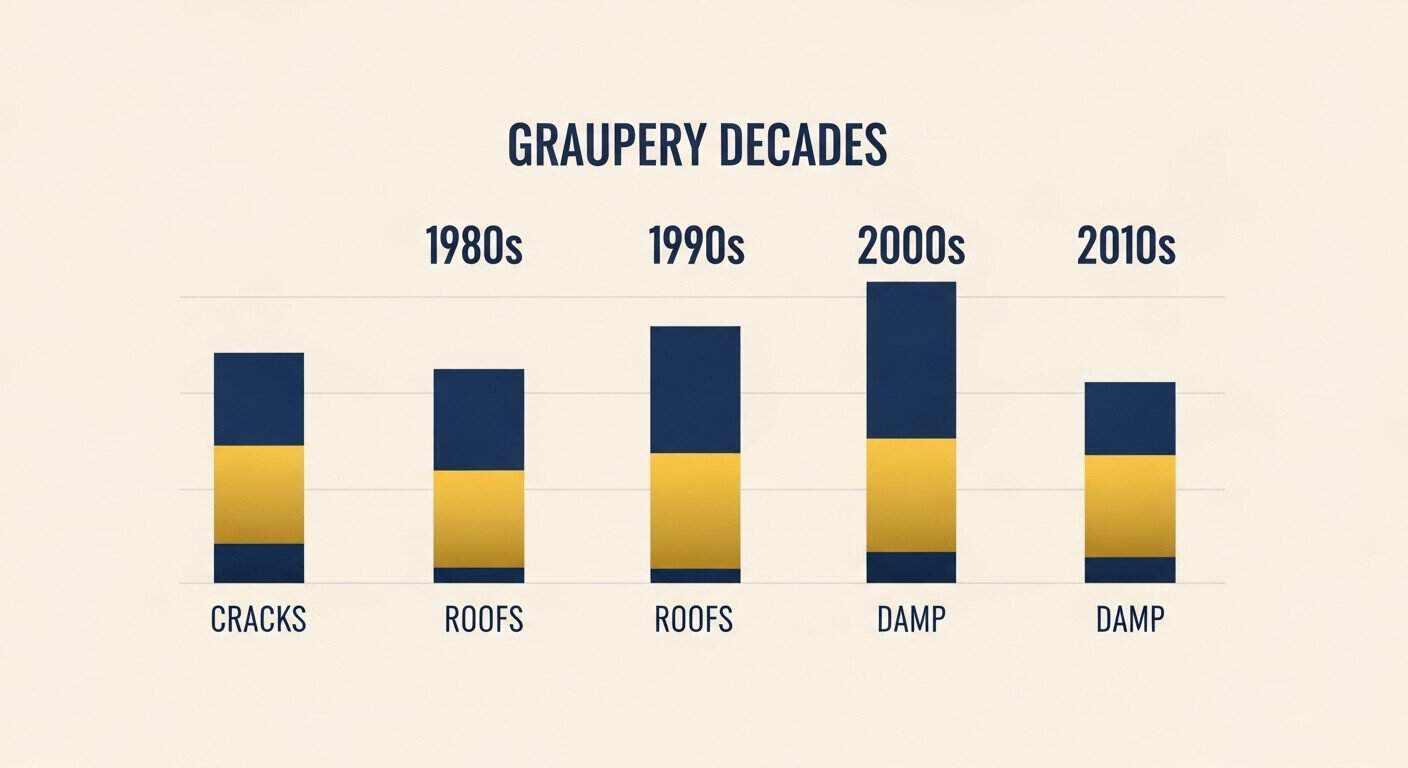
The result: a suburb full of solid, livable homes — but with a predictable set of age-related issues that turn up on inspection.
The Hoppers Crossing buyer defect checklist
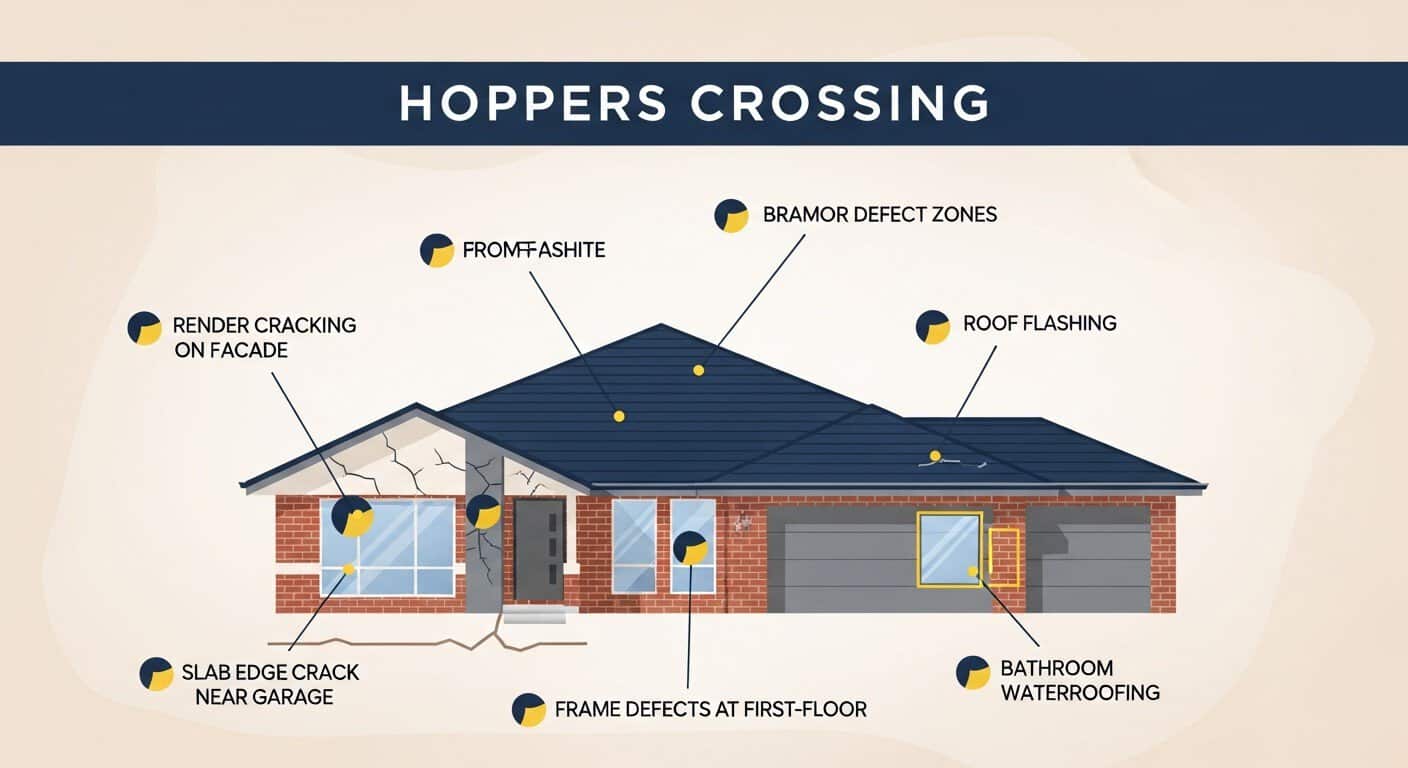
1. Stair-step brick cracking
What it looks like: diagonal cracks following the mortar joints, usually at corners, around windows, and at lintels.
What it means: seasonal slab movement on reactive clay. Crack width <3mm = cosmetic; 3-10mm = monitor; >10mm = structural review.
2. Slab edge heave
What it looks like: raised edge of the slab visible at the perimeter; floors sloping away from external walls.
What it means: the perimeter clay swells in winter, pushing the slab edge up. Common in 1980s-90s slab-on-ground homes without articulation joints.
3. Render detachment on rendered brick veneer
What it looks like: hollow-sounding render on tap test; visible cracks; flaking paint.
What it means: rendered brick veneer built 1995-2010 commonly used cement renders that don’t accommodate brick movement. Render detaches over time. Repair: re-render or remove and paint.
4. Sloping floors
What it looks like: marble rolls; furniture wobbles; doors don’t close.
What it means: measure with a digital level. >1:200 fall is a flag; >1:100 is a structural issue.
5. Original aluminium window seal failures
What it looks like: condensation between glass panels; black mould around window frames; air leaks.
What it means: 1980s-90s aluminium windows with original seals are at end-of-life. Budget $400-$1,200 per window for re-sealing or replacement.
6. Subfloor moisture (older homes)
What it looks like: musty smell, visible damp staining on subfloor timbers, white efflorescence on brick piers.
What it means: drainage issue. Subfloor ventilation insufficient or stormwater not directed away. Repair: regrade soil, add subfloor vents, possibly install drainage.
7. Roof tile lift after 30+ years
What it looks like: ridge capping cracked or missing; broken tiles; sarking visible from below.
What it means: original tiles are at warranty end. Re-bedding ridge capping and replacing broken tiles: $2,000-$5,000.
8. Asbestos in homes pre-1990
What it looks like: fibrous-cement eaves linings, fence sheets, garage walls, sometimes vinyl floor tiles.
What it means: if undisturbed, asbestos is not a hazard — but any renovation requires licensed asbestos handling. Factor this into renovation budgets for pre-1990 homes.
9. Termite conducive conditions
What it looks like: garden bed soil against weatherboards, timber retaining walls touching slab, subfloor moisture.
What it means: even if no termites are present today, conditions are favourable. Budget for treatment + termite barrier.
10. Original electrical switchboards (pre-1990)
What it looks like: fuse-style switchboards, no RCDs, no smoke alarms hardwired.
What it means: electrical safety upgrade required before insurance can be relied on. Switchboard upgrade: $1,500-$3,500.
Why local inspection matters
Need this inspection booked?
Star books inside the cooling-off window. 48-hour turnaround, same-day report, phone walkthrough.
A national-chain inspector visiting Hoppers Crossing for the first time reads these defects with no context. A VBA-registered builder who’s inspected hundreds of homes across the western corridor reads them in context: which are normal, which are red flags, and which are deal-breakers.
Star Building Inspections is based in Hoppers Crossing. Michael Tuder grew up inspecting homes in Werribee, Point Cook, Tarneit and Wyndham Vale. The local context isn’t a marketing line — it’s how we read the report.
Frequently asked questions
Are these defects common in newer Hoppers Crossing homes?
The post-2010 estates (Featherbrook, Wyndham Crest etc.) generally avoid the worst of the slab issues because of better footings. But render detachment and seal failures will start appearing as those homes hit 15+ years.
Should I avoid older Hoppers Crossing homes?
No. Most of the defects above are manageable and many are cosmetic. The point of inspection is to know which homes have stable defects vs. progressive ones — and to negotiate on the report.
Do you inspect across the western suburbs or only Hoppers Crossing?
Whole western corridor — Werribee, Point Cook, Tarneit, Truganina, Williams Landing, Plumpton, Melton West/South, Wyndham Vale, Manor Lakes.
Book a Hoppers Crossing pre-purchase inspection
Pre-Purchase Building & Pest Inspection — Melbourne West — VBA-registered builder based in Hoppers Crossing, same-day reports.
Related guides:
– Reactive Clay Soils in Melbourne’s West — Why Houses Crack
– 5 Defects Pre-Purchase Inspections Find in Older Melbourne Homes
– What Does a Pre-Purchase Building Inspection Actually Check?
Call Michael direct on 0412 014 216 to book.
Hoppers Crossing defects we see most often
What customers say about Star
Chain inspectors vs Star
| Factor | Chain inspector | Star (independent) |
|---|---|---|
| Inspector continuity | Rotating staff | Michael every time |
| VBA-registered builder | ✗ | ✓ |
| Report walkthrough | ✗ | yes — phone call |
| Same-day report | ✗ | yes (by 6pm) |
| Cost | $300-450 | $450-650 |
The standard buyer pre-purchase inspection often gets booked late — after the 3-day cooling-off period clock has started — and the report comes back too late, or too vague, to use as leverage.
Star books inside the cooling-off window, attends within 48 hours, and writes a report you can actually take to the agent. Photos of every defect, severity grades, and a phone walkthrough so you know what matters before you sign.
When you book Star
Across Melbourne's west
How we grade defects
Why book Star Building Inspections?
Star Building Inspections is owned and operated by Michael Tuder — a VBA-registered builder with 20+ years inspecting homes across Melbourne's western corridor. Michael personally attends every inspection, writes every report, and calls every customer to walk them through the findings line by line. No contractors. No rotating staff. No outsourced sign-offs.
Book your pre-purchase inspection
Cooling-off period running? Star books within 48 hours, attends in person, and delivers your report same day.