
If you own a pool or spa in Victoria, you have legal obligations that did not exist a few years ago. Since 1 December 2019 every owner has had to register their pool or spa with their local council, and at defined intervals an inspector must certify the safety barrier and lodge a Certificate of Compliance — the Form 23. Get it wrong, and the penalties stack up fast. I am Michael Tuder, registered builder, and I inspect pool barriers across Melbourne’s western suburbs. Here is what the law requires, what we look for, and the most common reasons for non-compliance.
Quick answer: In Victoria, owners of pools and spas containing more than 300mm of water must register with their local council and have the safety barrier inspected at defined intervals. The inspector lodges a Certificate of Compliance — Form 23 — with council if the barrier passes. Common failures include incorrect gate latch height, fence height under 1.2m, climbable zones inside the barrier, gaps under the fence, and direct access from the house through non-compliant doors or windows. Penalties for non-compliance can exceed $1,800 per breach.
What the law requires
Under Victoria’s Building Regulations 2018 and Building Act 1993, every owner of a pool or spa with more than 300mm of water must:
- Register the pool or spa with their local council
- Identify the construction date of the barrier — the construction date determines which barrier standard applies
- Have the barrier inspected by a registered building surveyor or registered building inspector
- Receive a Certificate of Compliance (Form 23) if the barrier complies
- Re-inspect on a defined cycle — typically every four years for an existing barrier
The construction date of the barrier dictates the standard:
| Barrier construction date | Applicable standard |
|---|---|
| Before 8 April 1991 | Some barrier required, with specific older provisions |
| 8 April 1991 – 30 April 2010 | AS 1926.1–1993, with relevant amendments |
| 1 May 2010 – 30 April 2020 | AS 1926.1–2007 |
| On or after 1 May 2020 | AS 1926.1–2012 |
Standards have tightened over time. A barrier built to 1993 standards is held to those standards, not to the current rules — but the inspector still needs to certify the barrier complies with what was in force at construction.
What the inspection covers
A pool safety inspection is not the same as a building inspection. The scope is narrow but specific. We check:
Fence height
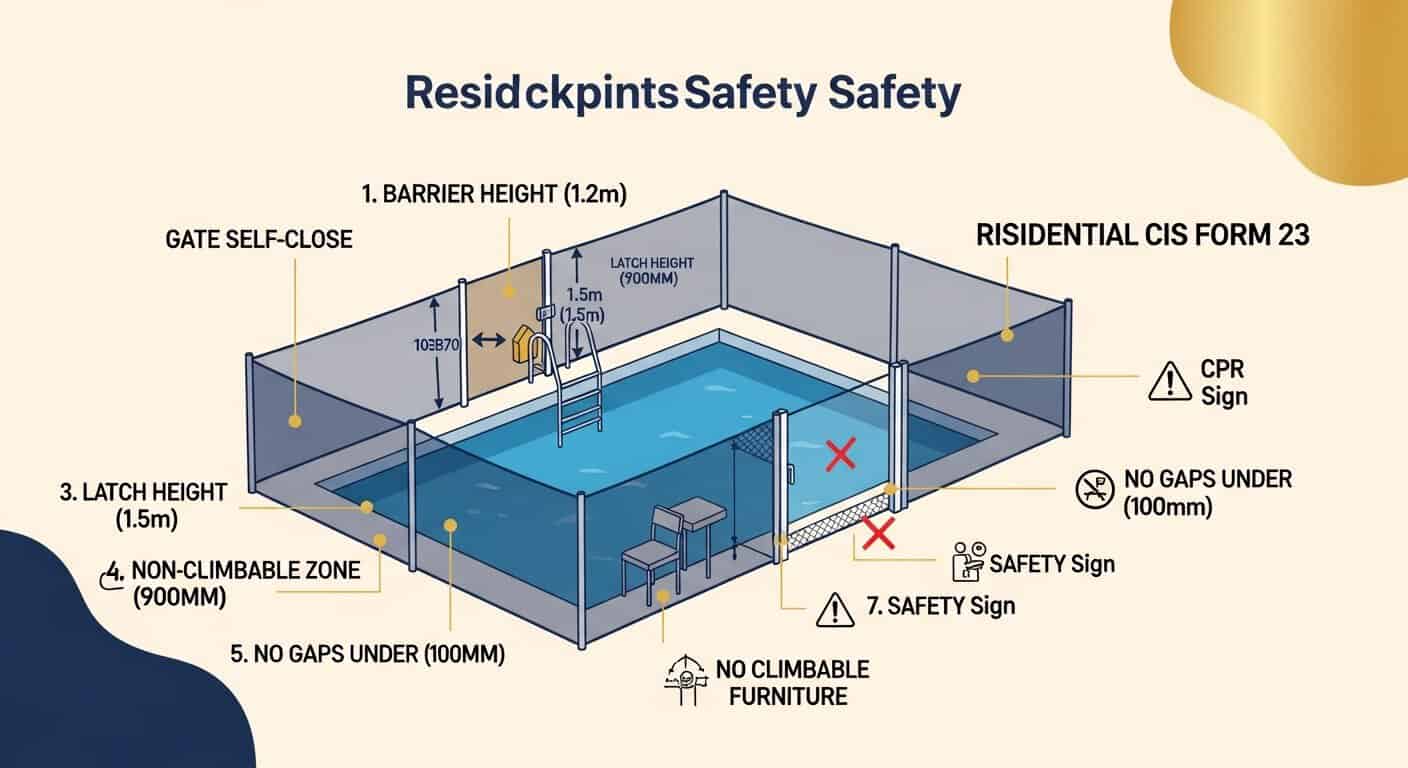
The barrier must be at least 1.2 metres high measured on the outside of the fence. Some older standards permitted lower heights in defined circumstances; most current pools require 1.2m minimum, with no climbable foothold within 900mm of the top.
[Image: pool fence with measuring tape showing 1.2m height]
Climbable zone
Inside the pool area, no horizontal surface above 100mm wide may be within 300mm below the top of the barrier — that gives a child a foothold. Outside the pool area, no climbable object may be within 900mm of the barrier and 1.2m above ground level — a tree, BBQ, retaining wall, or pot plant near the fence is a common failure.
Gaps and openings
- No vertical gap larger than 100mm anywhere in the barrier
- No gap under the fence larger than 100mm at finished ground level
- No openings within the gate that could be used for access
We carry a 100mm sphere — a “go/no-go” gauge — and check every gap.
Gate
This is where most barriers fail. The gate must:
- Be self-closing from any open position (release the gate at full open and it must close and latch on its own)
- Be self-latching with the latch at least 1.5m above ground on the outside of the gate, OR with a shielded release on the inside that prevents reach-through
- Open outward — away from the pool area
- Have no gap between the gate and post that exceeds 10mm
Failed gate hardware is the most common single cause of non-compliance. Self-closing hinges wear out. Latches drift out of alignment. Children’s pool drowning fatalities are disproportionately associated with gate failure.
Direct access from the house
If the pool barrier doubles as a wall of the house, doors and windows opening into the pool area must be:
- Doors — fitted with a child-restrictive device, OR replaced with a fence between the door and pool
- Windows — restricted to a 100mm opening, OR fitted with a child-restrictive device, OR fenced
A sliding door direct to the pool with no fence between is a common failure on older Melbourne renovations.
Common compliance failures
After inspecting pools across Hoppers Crossing, Werribee, Point Cook, and the Melton corridor, the same issues come up.
- Gate self-close failed — hinges have lost spring tension, gate does not latch from a 50mm-open position
- Climbable zone breached outside — tree branch, garden bed, BBQ, pot, or retaining wall providing a foothold within 900mm of the fence
- Climbable zone breached inside — pump housing, garden bed, or step within 300mm of the barrier inside
- Fence height short — 1.1m fence on a barrier built post-2010 (was permitted under earlier standards but not the current build date)
- Gap under the fence — bedding eroded, or built over a sloped surface that creates a >100mm gap at the low point
- Direct house access — doors and windows that need restrictors and do not have them
- Latch on outside fitted at hand height — common on older retrofits, not compliant
- Gate opens inward — built incorrectly, never inspected, now needs a hinge change
- Spa cover certified as the barrier — only certain locking spa covers count, and many used today are not compliant as a primary barrier
Penalties for non-compliance
Under Victorian law, penalties for failing to register and certify a pool barrier include:
- Fines for non-registration — over $1,800 per offence
- Fines for failing to lodge a compliance certificate — significant per-day penalties for ongoing breach
- Personal liability if a drowning occurs in a non-compliant pool
Non-compliance is not just a paperwork issue. The legal and financial consequences for an owner are real. The moral consequences if a child drowns are absolute.
The inspection process
Need a defensible report?
VBA-registered builder. AS/NCC-referenced. Court-ready if disputed.
Star Building Inspections runs a defined process:
- Confirm pool registration with council — if not registered, the owner registers first
- Identify the barrier construction date to determine the applicable standard
- Site inspection — typically 30–60 minutes
- Defect list issued same day if non-compliances are found
- Owner rectifies the issues
- Re-inspection confirms compliance
- Form 23 (Certificate of Compliance) lodged with council by the inspector
- Owner receives a copy for records
Most failures are fixed within a week — gate hinge replacement, climbable item moved, gap repaired. Major failures (fence too short, door restrictors needed) take longer.
When inspection is triggered
The cycle in Victoria for an existing certified barrier is generally every four years. A new barrier triggers inspection on completion. Sale of the property does not automatically trigger an inspection — but it is common for buyers to request a current Form 23 as a condition of sale, and many vendors arrange one as part of pre-sale presentation.
If you are buying a property with a pool and the vendor cannot produce a current Form 23, the pool barrier becomes your responsibility post-settlement. That is worth a conversation before contract signing.
Frequently asked questions
Does my spa need a barrier?
If the spa contains more than 300mm of water and is not fitted with a compliant locking lid, yes. Many freestanding portable spas do qualify for the locking-lid exemption. We can confirm against the model and standard.
Can I do my own inspection and lodge the form myself?
No. Form 23 must be lodged by a registered building surveyor or registered building inspector. Owners cannot self-certify.
What if my fence does not meet today’s standards but was compliant when built?
The inspection assesses against the standard in force at the time of construction of the barrier. A barrier built in 2005 is assessed against AS 1926.1–1993 (with amendments), not the 2012 standard. If the owner has substantially altered the barrier, the date of alteration may shift the applicable standard.
Do I need to inspect every four years even if nothing has changed?
Yes. The four-year cycle is set by regulation, not by changes to the barrier. Things wear out — hinges, latches, fence panels, gate alignment — and the cycle catches that.
How much does a pool safety inspection cost?
Typically $250–$500 for a standard residential pool, depending on size and complexity. Re-inspection after rectification is usually included or a small additional fee.
Do you inspect pools in Werribee, Point Cook, and Hoppers Crossing?
Yes — across all of Melbourne’s western suburbs. Inspections, defect lists, re-inspection, and Form 23 lodgement.
Book a pool safety inspection
If your pool is overdue for inspection, your last Form 23 is missing, or you have just bought a property with a pool, get the inspection booked. Star Building Inspections covers pool barriers across Melbourne’s west — Hoppers Crossing, Werribee, Point Cook, Tarneit, and beyond. Read more about our special purpose inspections, or call Michael on 0412 014 216.
Related reading:
– Dilapidation reports — when do you need one?
– Methamphetamine testing for Australian homes
CIS Form 23 — pool safety checks
What customers say about Star
When you book Star
Dilapidation, pool safety, owner-builder, meth — these reports need to stand up to lawyers, councils, and insurers. A generic checklist inspector won't cut it.
Star is a VBA-registered builder. Every special-purpose report references the specific Australian Standard, NCC clause, or council requirement that applies — written to be defensible if disputed.
How we grade defects
Across Melbourne's west
Why customers choose Star
Why book Star Building Inspections?
Star Building Inspections is owned and operated by Michael Tuder — a VBA-registered builder with 20+ years inspecting homes across Melbourne's western corridor. Michael personally attends every inspection, writes every report, and calls every customer to walk them through the findings line by line. No contractors. No rotating staff. No outsourced sign-offs.
Book a special-purpose inspection
Dilapidation, pool safety, owner-builder, meth — every report is AS/NCC-referenced and defensible if disputed.