

When a builder breaks ground next door, when council widens a road outside your home, or when a major infrastructure project starts within striking distance, your home is at risk. Vibration, ground movement, and direct construction impact can crack walls, damage retaining structures, or worse. A dilapidation report is the single document that protects you. I am Michael Tuder, registered builder, and after 30+ years inspecting Melbourne homes I have prepared dilapidation reports across the western suburbs for owners, builders, and councils. Here is when you need one, what it covers, and how to use it if damage occurs.
Quick answer: A dilapidation report is a detailed, photographed record of the existing condition of a building before nearby construction starts. It is used to prove what damage was — and was not — caused by the works. You need one if construction is planned within roughly 30 metres of your property, if council requires it, or if you want documented protection during major infrastructure works. Cost is typically $500–$1,200 for a residential property.
What a dilapidation report is
A dilapidation report is a baseline condition document. It records, with photos and descriptions, the existing condition of a building and its surrounds at a specific date — before adjacent works begin. The same building is then re-inspected after the works finish (a post-construction dilapidation report), and the two reports are compared.
If new damage has appeared between the two inspections, the second report identifies it. The pre-construction report is the evidence that the damage was caused by the works, not pre-existing.
Without a pre-construction dilapidation report, proving causation is almost impossible. The builder, the council, or the contractor will say the damage was already there. With a report, you have a dated, signed, photographed record that says otherwise.
When you need a dilapidation report
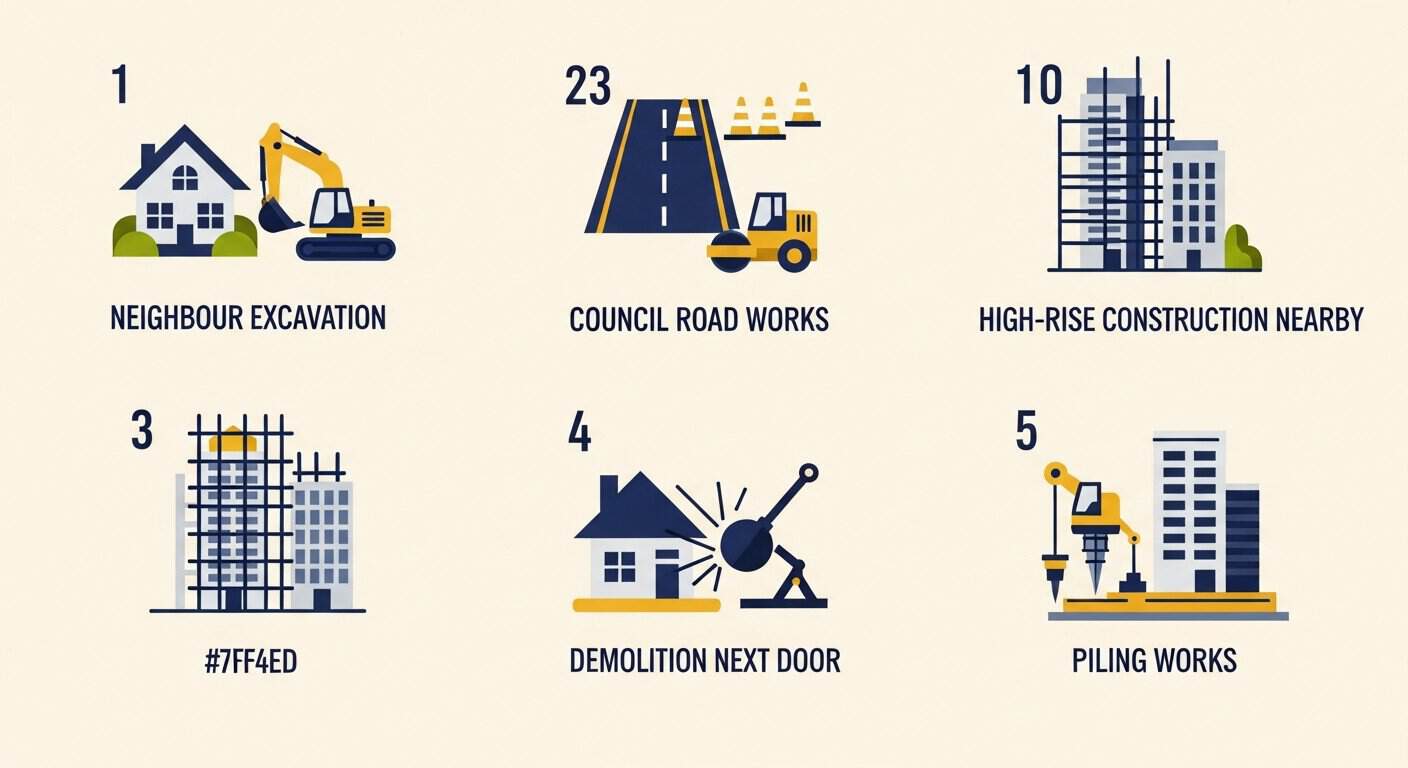
Five common triggers in Melbourne’s west:
1. The block next door is being developed
Townhouse builds, knockdown rebuilds, and small subdivisions are common across Hoppers Crossing, Werribee, Tarneit, Truganina, and Point Cook. Excavation, pile driving, slab pours, and heavy machinery within 5 metres of your wall create real risk of cracking, footing movement, and damage to retaining structures.
If the builder is professional, they will commission dilapidation reports on adjoining properties. If they are not, you should commission your own.
2. Council requires it as a permit condition
For multi-unit developments, larger projects, or sensitive sites, council often makes a dilapidation report a permit condition. The builder must arrange and pay for reports on adjoining properties before the permit is issued.
If you are an owner of an adjoining property, you generally do not pay — but you do consent to the inspection. Read the report when you receive it. If anything is wrong (missed defects, photos misrepresenting condition), raise it before you sign.
3. Major infrastructure works nearby
Road widening, level crossing removals, drainage projects, and rail works are common across Melbourne’s west. Where these works approach residential properties, dilapidation reports protect both the contractor (against false claims) and the owner (against unrecorded damage).
The Wyndham corridor in particular has had significant infrastructure activity. If a major project is planned within 30 metres of your home, ask the project authority whether dilapidation reports are part of the program.
4. You are the builder commissioning the works
If you are the builder of a knockdown rebuild, townhouse development, or any project where excavation, vibration, or heavy works are involved, dilapidation reports on adjoining properties protect you. They limit your exposure to claims for damage that pre-existed your works.
A professional builder always commissions dilapidation reports on adjoining properties before starting. The cost is small relative to the risk.
5. Voluntary protection during heavy works
Even where no permit requires it and no builder offers it, you can commission your own dilapidation report on your property if heavy works nearby concern you. The report is your insurance against future damage claims.
What a dilapidation report includes
Star Building Inspections prepares dilapidation reports to a defined scope. A typical residential report covers:
Building exterior:
- Every elevation, photographed from multiple angles
- Brickwork — every visible crack, pointed or flagged
- Render — surface condition, hairline cracks, patches
- Cladding — fixings, joints, paint condition
- Eaves and fascia — paint, fixings, rot
- Windows and doors — visible cracking around frames
- Roof — tile condition (where safely visible), flashings
Building interior:
- Every room photographed
- Plaster — every visible crack, mapped and photographed
- Cornice — joints, gaps, separation
- Floors — tile cracking, timber gaps, level
- Ceiling — cracks, stains, sagging
- Doors and windows — operation, gaps, frame movement
Site:
- Driveway and paths — cracks, levels
- Fencing — alignment, plumb
- Retaining walls — vertical, cracking, drainage
- Garden walls and brick piers
- Pool surrounds (where applicable)
Outbuildings:
- Garage, shed, carport — same scope as the main building
Every defect is photographed, dated, and described. The report is delivered as a photo-rich PDF, often running 60–200 pages depending on property size.
What dilapidation reports do not cover
The report is a record of visible condition at a point in time. It does not:
- Predict damage
- Assess risk from the planned works
- Recommend protective measures
- Provide engineering analysis
- Cover concealed framing or buried services
If you want a risk assessment, that is a structural engineer’s job, separate from the dilapidation report.
How to use the report if damage occurs
Need a defensible report?
VBA-registered builder. AS/NCC-referenced. Court-ready if disputed.
If new damage appears during or after the works, the process is:
- Photograph the new damage immediately, with a date stamp
- Compare against the pre-construction dilapidation report — if the damage is not in the report, it is new
- Notify the builder, contractor, or project authority in writing
- Commission a post-construction dilapidation report — same scope, same inspector ideally
- Use the comparison report as the evidence for the claim
The two reports together — pre and post — make causation almost unarguable. Without the pre-construction report, the burden of proof falls on you, and that is a fight you usually lose.
Who pays for the report
Depends on the trigger:
- Adjoining property owner during nearby works — usually the builder pays, with consent from the owner.
- Owner commissioning own report voluntarily — owner pays.
- Builder protecting against future claims — builder pays.
- Council or infrastructure project mandating — the project authority pays.
For a residential property in Melbourne’s west, expect $500–$1,200 for a pre-construction report. The post-construction comparison report is typically a similar fee. For larger or period properties, more.
Timing

The pre-construction report must be done before any works on the adjoining property start — including site clearance, demolition, or piling. Once works have started, the report cannot establish baseline condition.
Realistic lead times:
- Inspection booking — 1 to 2 weeks notice ideal
- Inspection on site — 2 to 6 hours depending on property
- Report delivery — same day to one business day
- Post-construction comparison — booked at completion of nearby works
If you have just learned that a nearby development is about to start and there is no dilapidation report planned, contact us immediately. We can usually inspect within a few business days.
Frequently asked questions
Can I rely on my own photos instead of a formal report?
No. Owner photos are easily disputed — undated, partial, taken to support a claim rather than document baseline condition. A formal report by a registered builder, photographed systematically, dated, and signed, is the document that holds up. Owner photos can supplement, not replace.
Does the dilapidation report tell me whether my house is at risk?
No. The report records existing condition. Risk assessment is structural engineering, separate scope.
What if the builder next door refuses to commission a report?
You can commission your own. The cost is yours, but the protection is real. If the builder is required by permit to commission reports on adjoining properties and refuses, raise it with council.
Are dilapidation reports needed for small renovations?
Usually not. The trigger is heavy works — excavation, piling, demolition, vibration. A bathroom reno next door is not a dilapidation event. A two-storey addition with footings work next to a shared boundary often is.
How long after the works do I have to claim damage?
Depends on the contract or insurance arrangement. Talk to your solicitor — claims are generally time-limited. Inspect post-works promptly.
Do you do dilapidation reports across Melbourne’s west?
Yes — Hoppers Crossing, Werribee, Point Cook, Tarneit, Truganina, Williams Landing, Wyndham Vale, Manor Lakes, Plumpton, and the Melton corridor. Same-day photo-rich PDF reports.
Book a dilapidation report
If construction is starting near your home — or if you are the builder of nearby works — get the pre-construction report booked early. Star Building Inspections prepares dilapidation reports across all of Melbourne’s western suburbs. Read more about our special purpose inspections, or call Michael on 0412 014 216.
Related reading:
– Methamphetamine testing for Australian homes
– Pool safety inspections in Victoria — the CIS Form 23 explained
When you need a dilapidation report
What customers say about Star
Why customers choose Star
Dilapidation, pool safety, owner-builder, meth — these reports need to stand up to lawyers, councils, and insurers. A generic checklist inspector won't cut it.
Star is a VBA-registered builder. Every special-purpose report references the specific Australian Standard, NCC clause, or council requirement that applies — written to be defensible if disputed.
Chain inspectors vs Star
| Factor | Chain inspector | Star (independent) |
|---|---|---|
| Inspector continuity | Rotating staff | Michael every time |
| VBA-registered builder | ✗ | ✓ |
| Report walkthrough | ✗ | yes — phone call |
| Same-day report | ✗ | yes (by 6pm) |
| Cost | $300-450 | $450-650 |
Across Melbourne's west
When you book Star
Why book Star Building Inspections?
Star Building Inspections is owned and operated by Michael Tuder — a VBA-registered builder with 20+ years inspecting homes across Melbourne's western corridor. Michael personally attends every inspection, writes every report, and calls every customer to walk them through the findings line by line. No contractors. No rotating staff. No outsourced sign-offs.
Book a special-purpose inspection
Dilapidation, pool safety, owner-builder, meth — every report is AS/NCC-referenced and defensible if disputed.