Quick answer: Owner-builder inspections are independent VBA-registered builder inspections of your own owner-builder project. They’re not legally mandated in Victoria — but they are essential. As an owner-builder, you carry the warranty risk for 10 years (and assume the structural defects liability when you eventually sell). An independent inspection at each stage gives you the documentation, expertise, and peace of mind a registered builder would normally provide.
Why owner-builders need independent inspections
When you take out an owner-builder permit in Victoria, you assume the role of the registered builder for your project. That means:
- Statutory warranty obligations — you carry the 10-year structural warranty when you sell
- Code compliance — every element of the build must comply with the NCC, AS standards, and your structural engineering plans
- Trade coordination — you’re the one ensuring the plumber’s rough-in matches the engineer’s plans
- Defect liability — if something goes wrong, it’s on you
Most owner-builders are not registered builders. They’re capable, motivated DIYers project-managing trades. They have the will to build well — but they don’t have the training to read engineering plans against the as-built work, or to spot the defects that trades sometimes leave.
That’s where independent inspections fill the gap.
What we inspect for owner-builders
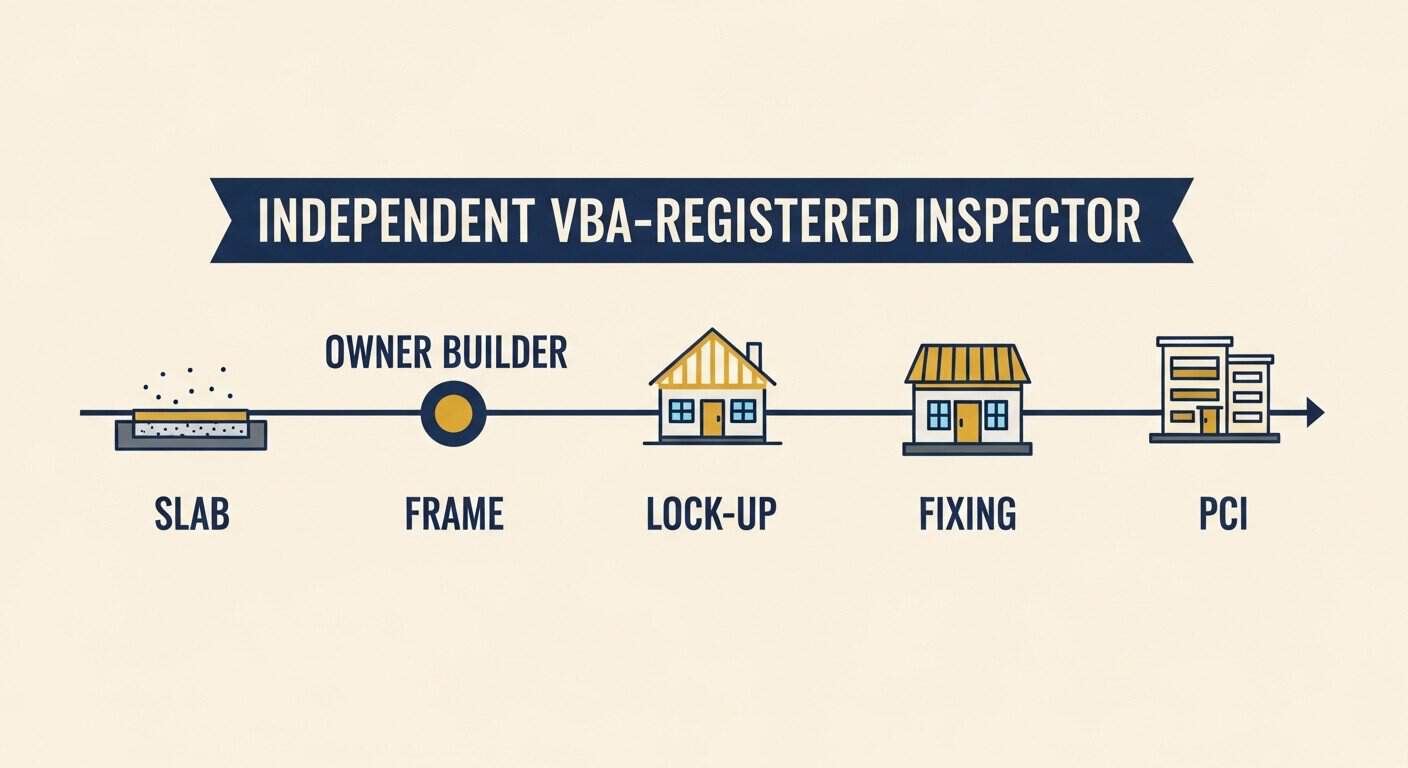
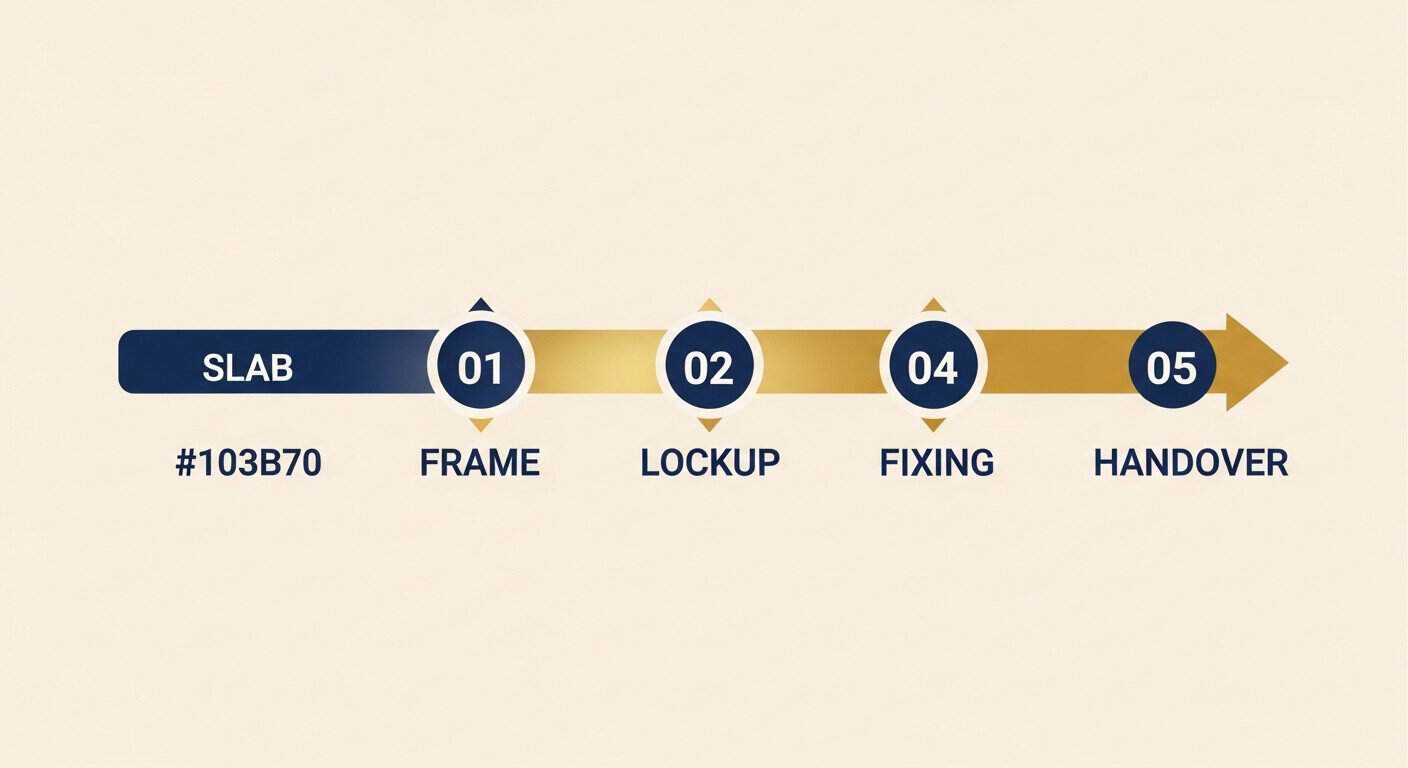
The same five-stage approach as a regular new home build:
- Pre-slab — formwork, reinforcement, vapour barrier, plumbing rough-in, termite shielding
- Frame — tie-downs, bracing, lintels, truss installation, wall plumb
- Lock-up / pre-plaster — waterproofing readiness, electrical and plumbing rough-in, sarking, flashings
- Fixing / waterproofing — wet-area waterproofing per AS 3740, internal fit-off readiness
- Practical completion — final defects walk-through
Each inspection gets a written, photo-rich report referencing the NCC and applicable AS standards.
What you get that registered builders typically don’t have
A registered builder’s project has:
– An in-house QA process
– Trade contracts that allocate defect liability
– A site supervisor walking the project daily
Owner-builders typically don’t. Independent inspections substitute for the missing site-supervisor role at the critical stages.
When the inspection report saves you
- Settling a trade dispute — the plumber says the rough-in is to plan; you have a documented inspection saying it’s not. Plumber fixes for free.
- Council inspection prep — your independent report often surfaces issues before the council inspector does, avoiding fail-and-redo cycles.
- Insurance claim — domestic building insurance for owner-builders requires evidence of due care; inspection reports are evidence.
- Selling the home later — Victorian law requires owner-builders to provide a defects report when selling within 6.5 years. Better to have current inspection records than retrospective ones.
Owner-builder warranty disclosure on sale
Need a defensible report?
VBA-registered builder. AS/NCC-referenced. Court-ready if disputed.
Section 137B of the Building Act 1993 requires owner-builders to provide a building inspection report to buyers when selling within 6.5 years of completion. The report must be prepared by:
- A registered building inspector, OR
- A registered builder, OR
- A surveyor / engineer
Star Building Inspections is run by a VBA-registered builder — qualified to issue these reports.
If you’ve been documenting your build with stage inspections all along, the section 137B inspection at sale time is straightforward: it’s an updated audit, not a retrospective one. If you haven’t, it’s a discovery exercise that might find expensive surprises.
What it costs
Per-stage inspections at fixed-fee pricing — typically $400-$600 per stage depending on home size. Often cheaper than what a registered builder would charge for the same role embedded in their margin.
For a full five-stage inspection package on a typical owner-builder home, budget $2,000-$3,000 across the build.
Frequently asked questions
I’m a tradesperson myself — do I really need this?
Many owner-builders are tradies. The independent inspection isn’t questioning your skills — it’s about the coordination across trades and compliance with the engineering plans. Even tradies benefit from a second set of qualified eyes.
Can the inspection report stand in for council inspections?
No — council inspections are a separate statutory process. But independent inspections often catch issues before council, saving you the time and stress of a fail-and-redo.
What happens if the inspection finds something serious?
Same as any build — fix it before proceeding. Better to fix at frame stage than at PCI.
Do you also do the section 137B sale inspection?
Yes. Call 0412 014 216 to book — same VBA-registered builder, same standard, fully compliant.
Book an owner-builder inspection
Special-Purpose Building Inspections — Melbourne — VBA-registered builder, owner-builder inspections, dilapidation reports, expert witness reports.
Related guides:
– Dilapidation Reports — When Do You Need One?
– The 5 Stages of a New Home Build
– Why Your Builder’s Inspection Is Not Enough
Call Michael direct on 0412 014 216 to book.
Owner-builder inspection sequence — VBA-registered oversight
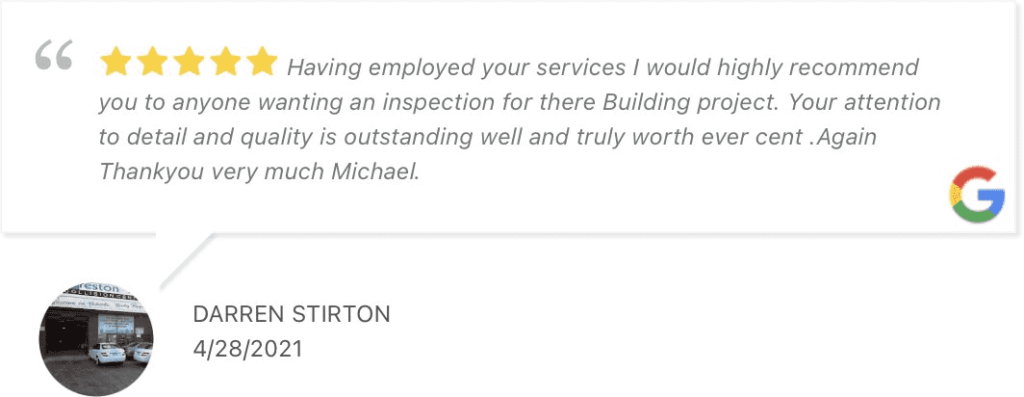
What customers say about Star
Chain inspectors vs Star
| Factor | Chain inspector | Star (independent) |
|---|---|---|
| Inspector continuity | Rotating staff | Michael every time |
| VBA-registered builder | ✗ | ✓ |
| Report walkthrough | ✗ | yes — phone call |
| Same-day report | ✗ | yes (by 6pm) |
| Cost | $300-450 | $450-650 |
Dilapidation, pool safety, owner-builder, meth — these reports need to stand up to lawyers, councils, and insurers. A generic checklist inspector won't cut it.
Star is a VBA-registered builder. Every special-purpose report references the specific Australian Standard, NCC clause, or council requirement that applies — written to be defensible if disputed.
When you book Star
Across Melbourne's west
How we grade defects
Why book Star Building Inspections?
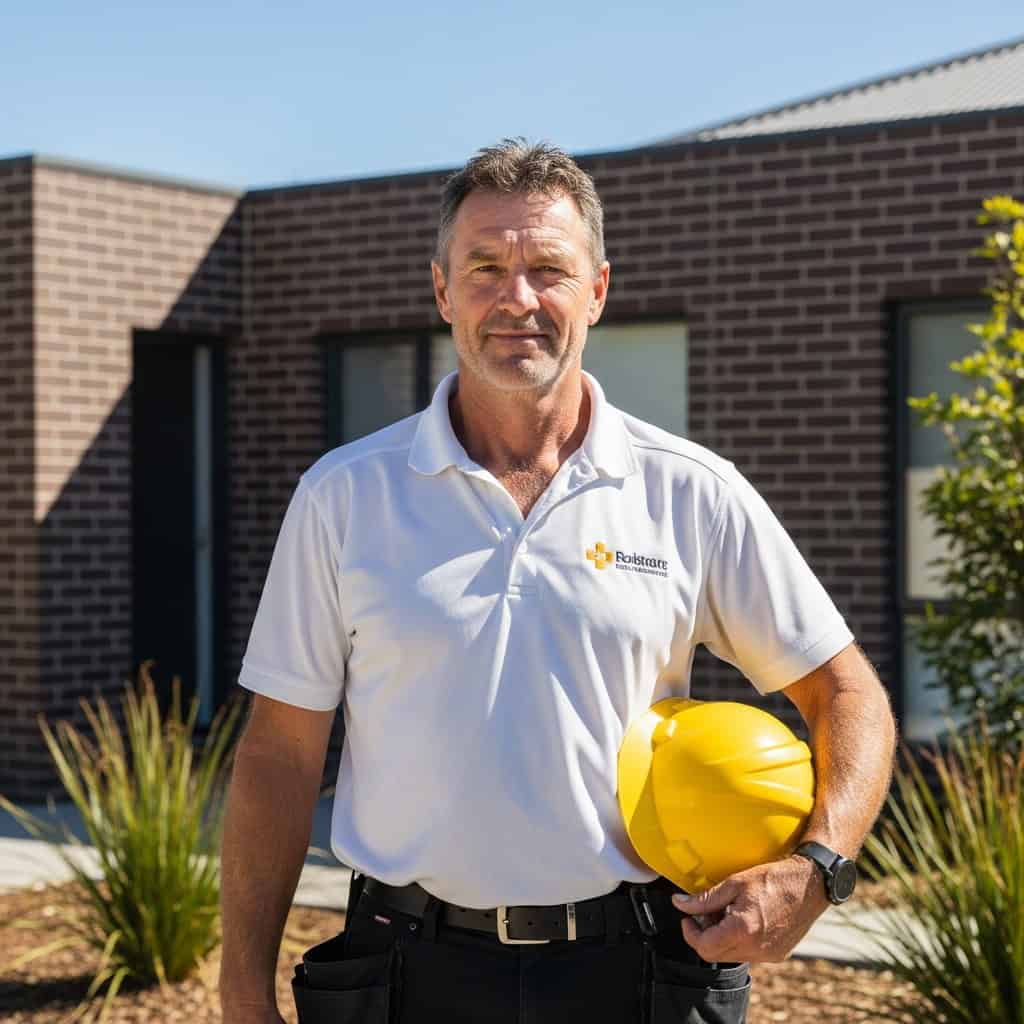
Star Building Inspections is owned and operated by Michael Tuder — a VBA-registered builder with 20+ years inspecting homes across Melbourne's western corridor. Michael personally attends every inspection, writes every report, and calls every customer to walk them through the findings line by line. No contractors. No rotating staff. No outsourced sign-offs.
Book a special-purpose inspection
Dilapidation, pool safety, owner-builder, meth — every report is AS/NCC-referenced and defensible if disputed.