
The Practical Completion Inspection (PCI) is the last stage in your new build, and the last chance to record defects under the contract. Once you sign for handover, the builder’s job changes from “build to contract” to “warranty work only” — and your leverage drops sharply. I am Michael Tuder, registered builder, and over 30+ years I have walked thousands of PCIs across Melbourne’s western suburbs. This is the structured checklist we use, room by room, so nothing slips through.
Quick answer: A thorough PCI checks every room, every wet area, every external surface, the roof, the garage, and the site against the contract, the plans, and the code. A typical Melbourne new home produces a defect list of 30 to 100 items. Anything fewer than 20 is a sign the inspection was rushed. Never sign handover before the defect list is rectified or formally agreed in writing.
What “practical completion” actually means
Practical completion does not mean perfect. It means the home is “reasonably suitable for occupation” — the National Construction Code is met, the contract scope is built, and outstanding items are minor and capable of being fixed without disrupting use. That definition leaves room for interpretation. The PCI is where you push that interpretation in your favour by documenting every defect, large or small.
If you sign handover without a documented defect list, you are accepting the home as-is. Builders’ rectification of items raised after handover is slow, partial, and at the builder’s discretion under warranty. Get the list in writing before you sign.
How to run the PCI
Allow at least 90 minutes on site. Bring:
- A torch (raked light reveals plaster and paint defects)
- Tape measure
- Spirit level (a small one)
- A pen and a sticky pad of dot stickers — tag each defect on a wall, photograph the tag and defect together
- The plans and contract specifications
- A camera (your phone is fine)
Better still, engage an independent registered builder to do it with you. See our post on why your builder’s inspection is not enough for why.
Exterior and roof
Walk the perimeter first. Defects outside often point to defects you will then look for inside.
Roof:
- Tile or sheet condition — chipped, cracked, lifted
- Ridge capping — straight, fully bedded, pointed
- Valleys — debris, lap, sealing
- Flashings — chimney, vents, skylights, wall abutments
- Gutters and downpipes — fall, fixings, joins, grates
- Eaves — paint, fixings, vents
Walls and cladding:
- Brickwork — articulation joints present, weep holes clear, mortar consistent
- Render — cracks, hairline movement, patches
- Cladding sheets — joints, fixings, sealants
- Paint finish — under raked light, all elevations
- Window frames — square, sealed, packed, locks operate
- Door frames — same
Site:
- Driveway — finish, fall away from house, expansion joints
- Paths — fall, joints, edges
- Surface drainage — pits, grates, fall to street
- Fencing — height, gates, latches
- Landscaping (if in scope)
- Letterbox, clothes line, hot water unit setting, AC condensers
[Image: brick veneer with weep holes and articulation joint at PCI]
Garage
The garage is often the most rushed part of the build. Trades finish the showy areas first.
- Garage door operation, weather seals, manual release
- Internal door from garage to house — fire-rated where required
- Slab finish, cracks, dust
- Walls and ceiling — paint, plaster
- Lighting and power points
- Roller door tracks and motor
Inside — every room
Use the same micro-checklist for every room, every time.
Walls and ceilings:
- Paint finish under raked light — roller marks, lap lines, patches
- Plaster joints — flat, no visible bumps or recesses
- Cornice — joins, gaps, mitres
- Internal corners — straight, no plaster cracks
- Skirting and architrave — mitres, scribes to floor, paint
Floors:
- Carpet — joins, edges, stretch, debris
- Timber/laminate — finish, expansion gaps, scratches, lift
- Tiles — lippage (max 1mm), grout colour and finish, drumminess
- Vinyl — joins, edges, bubbles
Doors and windows:
- Doors — operation, gaps top/bottom/sides, locks, latches, hinges
- Door stops in place
- Architraves square and tight
- Windows — operation, locks, screens, weep holes clear
- Sills — finish, sealing
Power and data:
- Every power point present per plan
- Light switches — present, oriented correctly, function
- Data points present per plan
- Smoke alarm in correct location, hard-wired, interconnected
- Light fittings as specified, function
Joinery:
- Built-in robes — doors operate, internal fitout, shelves
- Linen closet, pantry — same
[Image: PCI dot sticker on architrave showing paint defect]
Wet areas — bathrooms, ensuites, laundry, WC
Wet areas are where post-handover failures are most expensive. Inspect ruthlessly.
- Tiling — lippage, grout colour and joints, edge trims
- Silicone — full beads to floor and walls, no gaps, neat
- Shower screen — installed plumb, sealed, operates
- Shower base / hob — fall to drain (test with water)
- Floor waste — flush with finished floor, water flows freely
- Taps — operate, no leaks, finished trim plates
- Mixer alignment, shower rose
- Vanity — drawers, doors, sealing to wall, basin sealing
- Toilet — operates, sealed to floor, flush mechanism
- Mirrors — fixed, no edge damage
- Towel rails, toilet roll holders, hooks — installed per plan, fixed firm
- Exhaust fans — operate, ducted to outside (not roof void)
- Bath — sealed, drains, no chips or scratches
Laundry specifically:
- Washing machine taps and waste at correct heights
- Trough — sealed, drains
- Cabinetry — clear of trough where required
- Dryer vent (if installed)
Kitchen
Building right now?
Star catches stage defects while your builder still has to fix them. Slab, frame, lock-up, fixing, PCI.
The kitchen is the second-most-defect-prone area at PCI.
- Bench top — joins, edges, scratches, sealing to walls
- Splashback — installation, sealing, finish
- Cabinets — doors, drawers, runners, soft-close, alignment
- Cabinet interiors — shelves, fittings, finish
- Sink — sealed, drains, taps function, no leaks underneath
- Cooktop — installed, gas/electric connection, function
- Oven — door operation, racks, function, clean
- Range hood — operates, ducting routed correctly (not into roof void)
- Dishwasher — installed, runs cycle, no leaks
- Power points to bench — present per plan
- Pantry — shelving, doors
Outside the house, post-internal walk
Once you have done the internal walk, return outside to check items that often only become obvious after seeing the inside.
- AC outdoor unit — installed, secured, drainage
- Hot water unit — installed, certified, drainage
- Gas meter — labelled
- Solar (if installed) — panels secured, inverter accessible
- Sub-floor access (if accessible) — clean, ventilated
- Roof void access (if accessible) — sarking intact, no debris, ducting routed correctly
Documentation handover
Before you sign, you should receive:
- Occupancy certificate / certificate of final inspection
- Builder’s warranty documentation
- Manufacturer warranties for appliances, windows, hot water unit, AC, garage door
- Operating manuals
- Termite barrier installation certificate (where applicable)
- Waterproofing certificate
- Electrical compliance certificate (CES)
- Plumbing compliance certificate
- Owner’s manual for the home
If any of these are missing, do not sign until they are provided. The certificates are required for warranty claims and future sale.
What to do with the defect list
After the PCI walk-through:
- Issue the full defect list to the builder in writing the same day, with photos
- Ask for a written timeline for rectification
- Ask for a re-inspection appointment after rectification
- Withhold final progress payment until the re-inspection passes
- Do not sign for handover until all major defects are rectified or formally agreed in writing as outstanding
Builders push to settle the final payment and hand over keys. The contract usually allows you to withhold settlement until practical completion is genuinely met. Ask your conveyancer for advice on payment retention.
Frequently asked questions
How many defects is “normal” at PCI?
On a typical Melbourne volume builder home, 30 to 80 items is normal. Custom builds often run 40 to 100. Fewer than 20 means the inspection was not thorough enough.
The builder says I cannot bring an independent inspector. Is that allowed?
Standard residential contracts allow inspections at agreed times. Refusing an independent PCI is a flag — there is usually a reason. Talk to your contract administrator or solicitor.
What is the difference between PCI and the building surveyor’s final inspection?
The building surveyor inspects for code compliance and signs the occupancy certificate. That is a regulatory pass/fail. PCI is your contract inspection — it covers code plus contract spec plus quality. They are different inspections with different scope.
Can I refuse to settle if defects are not fixed?
Often yes, depending on the contract. Most contracts allow practical completion to be disputed and settlement withheld for defects beyond cosmetic. This is contract law — talk to your conveyancer or solicitor before withholding payment.
Should I do a second PCI after rectification?
Yes. A re-inspection confirms the defects are actually fixed and not just ticked off. It is also when builders sometimes “fix” one item and create another.
Do you do PCI inspections in Werribee, Tarneit, and Hoppers Crossing?
Yes — across all of Melbourne’s western suburbs. Same-day photo-rich reports.
Book your PCI inspection
Do not sign handover blind. Star Building Inspections runs registered-builder PCI inspections across Hoppers Crossing, Tarneit, Werribee, Point Cook, and the rest of Melbourne’s west. Read more about our stage inspections service, or call Michael on 0412 014 216.
Related reading:
– The 5 stages of a new home build (and what to inspect at each)
– Why your builder’s inspection is not enough
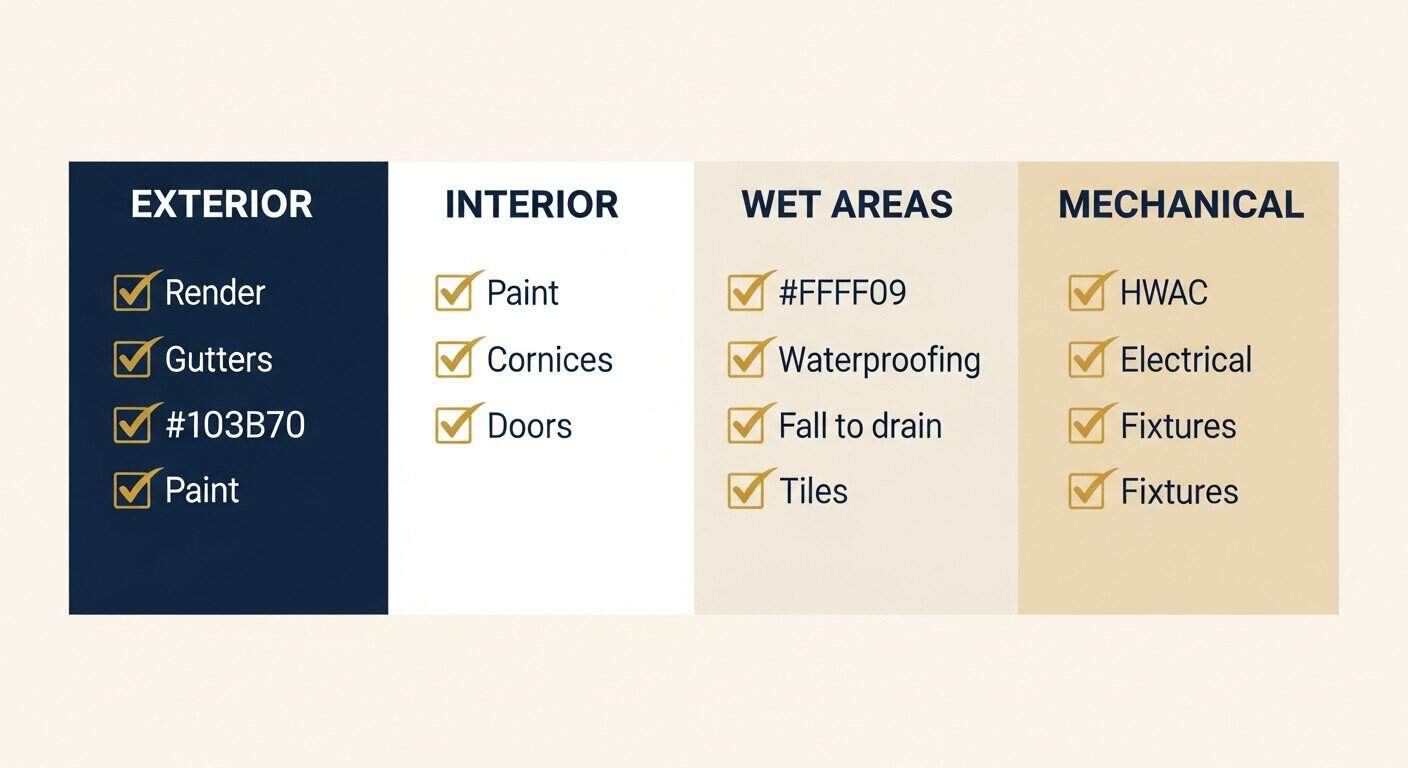
PCI checklist — defect categories at handover
What customers say about Star
Why customers choose Star
Your builder's "inspector" is paid by the builder. Their job is to sign off, not to find defects. By the time you spot the issue at handover, contracts are signed and the build company has moved on.
Star is an independent VBA-registered builder hired by you, not by the builder. We attend at slab, frame, lock-up, fixing and PCI stages — finding defects while the builder still has to fix them under contract.
Chain inspectors vs Star
| Factor | Chain inspector | Star (independent) |
|---|---|---|
| Inspector continuity | Rotating staff | Michael every time |
| VBA-registered builder | ✗ | ✓ |
| Report walkthrough | ✗ | yes — phone call |
| Same-day report | ✗ | yes (by 6pm) |
| Cost | $300-450 | $450-650 |
Across Melbourne's west
When you book Star
Why book Star Building Inspections?
Star Building Inspections is owned and operated by Michael Tuder — a VBA-registered builder with 20+ years inspecting homes across Melbourne's western corridor. Michael personally attends every inspection, writes every report, and calls every customer to walk them through the findings line by line. No contractors. No rotating staff. No outsourced sign-offs.
Book your stage inspection
Slab, frame, lock-up, fixing or PCI — independent oversight catches defects while your builder still has to fix them under contract.