
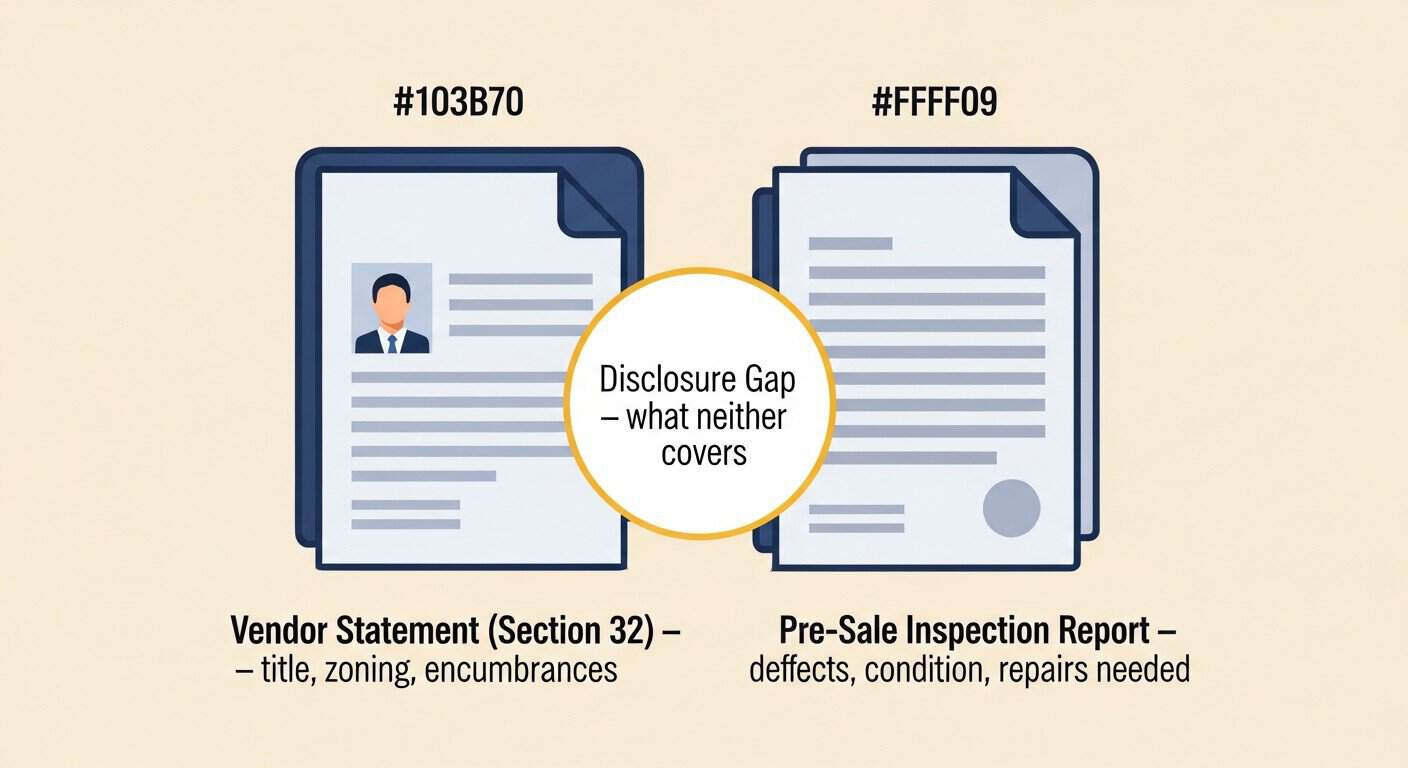
Sellers in Victoria face two related but separate documents in any property sale: the Section 32 vendor’s statement (a legal disclosure) and a voluntary vendor’s building inspection report (a building-condition document). They get confused regularly. After 30+ years inspecting Melbourne homes, I see the same questions come up — what each covers, who prepares it, and whether one replaces the other. This post draws the line between them, in plain English, from a builder’s perspective.
Quick answer: Vendor disclosure (the Section 32 in Victoria) is a legally required document that discloses defined matters about the property — title, encumbrances, planning, services, notices. A vendor inspection (pre-sale building inspection) is a voluntary report on the physical condition of the building. They are different documents, with different scope, different preparers, and different purposes. You usually want both.
What the law requires — Section 32
Under Victoria’s Sale of Land Act, a vendor must give the prospective buyer a vendor’s statement — universally called the Section 32 — before the buyer signs the contract of sale. That document is a legal disclosure. It is prepared by your conveyancer or solicitor, not by a builder.
The Section 32 typically includes:
- Title details and any encumbrances (mortgages, easements, covenants)
- Planning and zoning information
- Outgoings — rates, body corporate fees, taxes
- Services connected (water, sewer, gas, electricity, telecoms)
- Building permits issued in the last 7 years
- Owner-builder warranty insurance (where applicable)
- Notices, orders, or proposals affecting the property
- Bushfire-prone area declarations
- Information about any planning, building, or environmental notices
If the Section 32 is wrong or incomplete, the buyer can rescind the contract before settlement. That is a serious legal consequence. Your conveyancer carries the responsibility.
This post is not legal advice. For specific questions about your Section 32, talk to your conveyancer or solicitor.
What the law does not require — building condition
Here is the important part: the Section 32 does not require you to disclose the physical condition of the building. There is no legal obligation in Victoria for a vendor to inspect the building, document defects, or share defect information with the buyer.
The default rule is caveat emptor — buyer beware. The buyer is expected to do their own due diligence, which is why most buyers commission their own pre-purchase inspection.
That changes the dynamic of the sale. The buyer’s inspector will find what they find. You have no opportunity to position the findings, fix the issues first, or set context. The buyer reacts to the report cold.
A voluntary vendor inspection (pre-sale inspection) lets you change that.
What a voluntary vendor inspection adds
A vendor inspection is a building condition report you commission before listing. It is the same scope as a pre-purchase inspection — Australian Standard AS4349.1 (building) and AS4349.3 (pest where included).
It covers:
- Roof exterior, roof void, sub-floor where accessible
- Interior — walls, ceilings, floors, doors, windows
- Wet areas — tiling, grout, silicone, fixtures
- Kitchen — bench, cabinets, appliances visible
- Exterior — cladding, render, brick, eaves, fascia
- Site — drainage, paving, retaining walls, fencing
- Visible electrical and plumbing
- Pest activity and conducive conditions
You receive a same-day photo-rich PDF report. You decide what to do with it.
For more on the value of doing this, see our post on whether you should get a pre-sale building inspection.
How they fit together
The two documents work in parallel, not in competition.
| Section 32 | Vendor building inspection | |
|---|---|---|
| Required by law | Yes | No |
| Prepared by | Conveyancer / solicitor | Registered builder / qualified inspector |
| Covers | Legal disclosures (title, planning, notices, services) | Physical condition of the building |
| Standard | Sale of Land Act 1962 (Vic) | AS4349.1, AS4349.3 |
| Cost | $300–$700 typical | $400–$650 typical |
| Timing | Must be given to buyer before contract signed | Optional, before listing or during marketing |
| Consequence if missing or wrong | Buyer can rescind contract | None — but buyer’s inspection may find problems |
The Section 32 answers the legal question: “is the title clean, is there anything legally wrong with this property?” The vendor inspection answers the physical question: “what condition is the building in, and what defects exist?”
A buyer with both documents has a much clearer picture of what they are buying. A vendor with both has documented their position on both fronts before the buyer’s inspector arrives.
When the two overlap
Two areas where the documents touch:
Building permits
The Section 32 lists building permits in the last 7 years. The vendor inspection often surfaces work that should have had a permit but did not — extensions, decks, structural alterations, re-stumping. If the inspection finds unpermitted work, the Section 32 may need to address it. Talk to your conveyancer.
Building work outside the 7-year window
The Section 32 only covers permits in the last 7 years. The vendor inspection looks at the building as it stands today, regardless of when the work was done. Older unpermitted work shows in the inspection but not the Section 32.
Disclosure of the inspection report
About to list your home?
Find your defects before the buyer does. Defends asking price, speeds settlement.
Whether you give your inspection report to the buyer is your choice. The options:
Share it upfront — through your agent, alongside the Section 32 in the marketing pack. Builds trust, shows transparency, signals that you have done your homework.
Hold it back — and offer it only when a buyer asks for an inspection. Some buyers will accept your inspection rather than commissioning their own; others want their own.
Use it for your own decisions only — fix the defects you want fixed, disclose nothing voluntarily, and let the buyer’s inspection run its course.
A good agent helps you decide based on the property, the market, and the asking price. There is no single right answer.
What the vendor inspection does not do
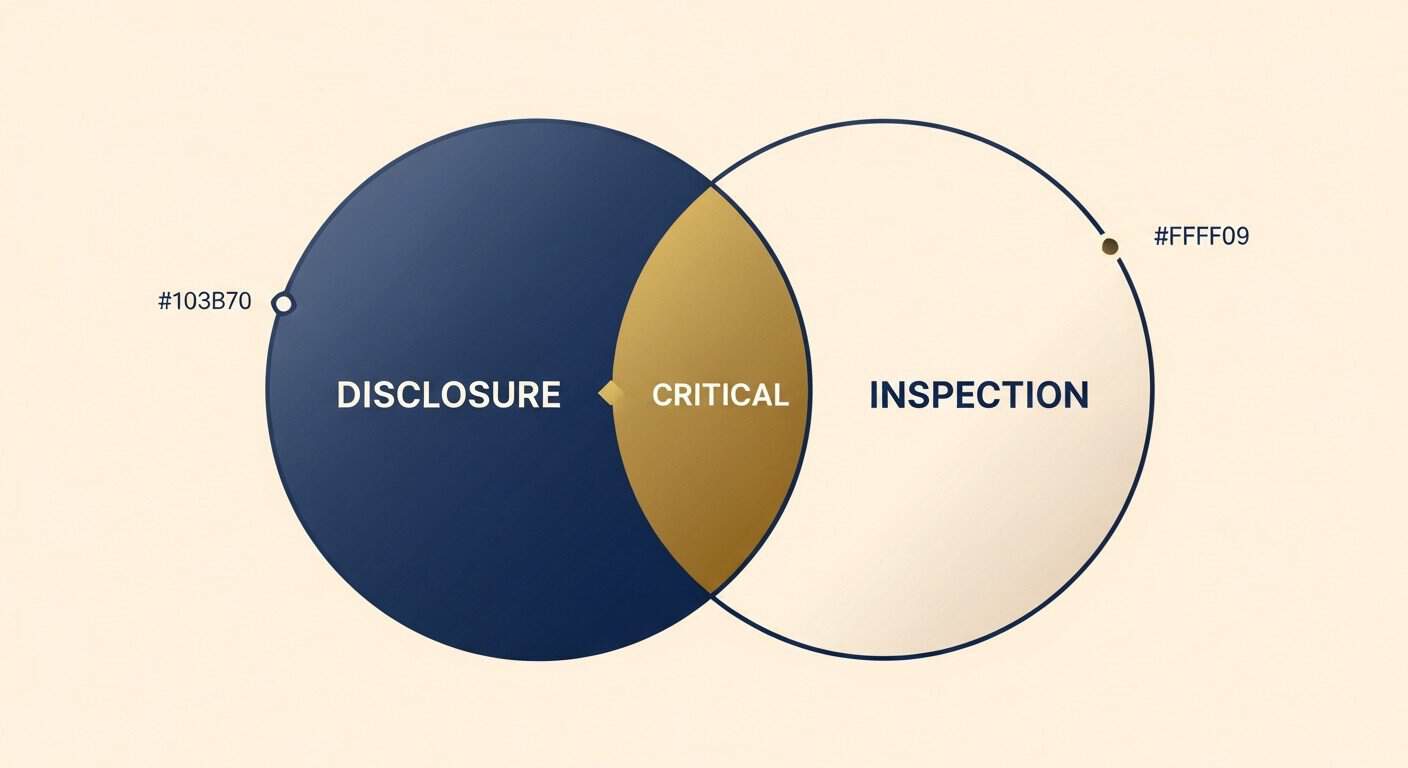
Important boundaries:
- It is not a Section 32. It does not satisfy any legal disclosure obligation.
- It is not a planning or compliance audit. It does not certify that all work was permitted.
- It does not replace a structural engineer’s report for active movement.
- It is not legal advice on your disclosure obligations.
If the inspection raises a question that crosses into legal territory — disclosure, contract terms, retrospective approvals — that is conveyancer territory.
What buyers think when they see both documents
Here is the buyer’s perspective. They receive your Section 32 and a vendor’s building inspection from a registered builder. Their reaction:
- “The vendor has nothing to hide on title.”
- “The vendor has documented the building condition independently.”
- “The defects listed are the defects I will find — no surprises.”
- “I can either accept this report or commission my own to confirm.”
Compare that to receiving only the Section 32 with no inspection. The buyer’s default is suspicion: what is the vendor not telling me? They commission their own inspection, find what they find, and react.
Most experienced agents in Melbourne’s west will tell you that vendor inspections — especially on older homes — make sales smoother and protect prices.
Frequently asked questions
Do I have to disclose defects I know about?
Talk to your conveyancer. Victorian disclosure law focuses on the matters listed in the Section 32. Beyond that, there is a general principle that you cannot actively mislead a buyer (don’t paint over a known leak, for example), but you generally do not have to volunteer building condition information that is not in the Section 32. Your conveyancer is the right person to advise on the line.
Can my vendor inspection be used by multiple buyers?
Technically yes, but practically each buyer’s lender or conveyancer may want a fresh inspection. Many vendors share the report with serious buyers as additional information rather than a substitute for the buyer’s own inspection.
Is a vendor inspection report worth more if it is recent?
Yes. A report under three months old reflects current condition. Older reports get less weight from buyers. If your home does not sell in the first marketing campaign, expect to need a refresh.
Does the vendor inspection cover the things in the Section 32?
No. The two cover different territory. The vendor inspection looks at the building. The Section 32 looks at the legal context. You usually want both.
Can the inspector help me draft the disclosure?
No. Inspectors are not legally qualified to advise on disclosure. We inspect and report on building condition. Disclosure questions go to your conveyancer.
Do you do vendor inspections in the Wyndham and Melton corridors?
Yes — Hoppers Crossing, Werribee, Point Cook, Tarneit, Wyndham Vale, Manor Lakes, Plumpton, and Melton South and West. Same-day photo reports.
Book a vendor pre-sale inspection
The Section 32 is your conveyancer’s job. The building condition report is ours. Star Building Inspections runs registered-builder pre-sale inspections across Melbourne’s west, with same-day PDF reports you can take to your agent or hold for your own decisions. Read more about our pre-sale building inspection service, or call Michael on 0412 014 216.
Related reading:
– Should you get a pre-sale building inspection before listing?
– Top defects pre-sale inspections find that derail home sales
Vendor disclosure vs pre-sale inspection
| Coverage | Vendor Statement | Pre-Sale Report |
|---|---|---|
| Title + zoning | ✓ | ✗ |
| Encumbrances | ✓ | ✗ |
| Structural condition | ✗ | ✓ |
| Active defects | ✗ | ✓ |
| Termite check | ✗ | ✓ |
| Repair cost estimates | ✗ | ✓ |
| Required by law | yes (s.32) | no — but worth it |
What customers say about Star
How we grade defects
You list, buyers inspect, their report finds 3 issues you didn't know about, and the deal falls over or gets re-negotiated 20k below your asking price.
Star does a pre-sale inspection BEFORE you list. You see the report first, fix what's cheap, disclose what isn't, and remove the buyer's "gotcha" leverage entirely.
Why customers choose Star
Across Melbourne's west
Chain inspectors vs Star
| Factor | Chain inspector | Star (independent) |
|---|---|---|
| Inspector continuity | Rotating staff | Michael every time |
| VBA-registered builder | ✗ | ✓ |
| Report walkthrough | ✗ | yes — phone call |
| Same-day report | ✗ | yes (by 6pm) |
| Cost | $300-450 | $450-650 |
Why book Star Building Inspections?
Star Building Inspections is owned and operated by Michael Tuder — a VBA-registered builder with 20+ years inspecting homes across Melbourne's western corridor. Michael personally attends every inspection, writes every report, and calls every customer to walk them through the findings line by line. No contractors. No rotating staff. No outsourced sign-offs.
Book a pre-sale inspection
Find your home's issues before the buyer does. Defends asking price, removes the buyer's 'gotcha' leverage, speeds the settlement.